

Sane Agressor Evolution StarLight 2026
A light, forgiving teardrop that gets the ball moving easily, with a broad sweet spot for calm defense and quick net exchanges.
Our Take
Shape
Tear
Weight
345 - 365 gr
Touch
Medium
Core
Pro Ctrl
Faces
NanoGraf (fiberglass with graphene)
What we like
- Easy depth from the baseline
- Broad sweet spot on off-center hits
- Fast handling for net blocks
What we don't
- Limited smash mass and finish
- Less bite on sliced volleys
- Flat swings can overhit depth
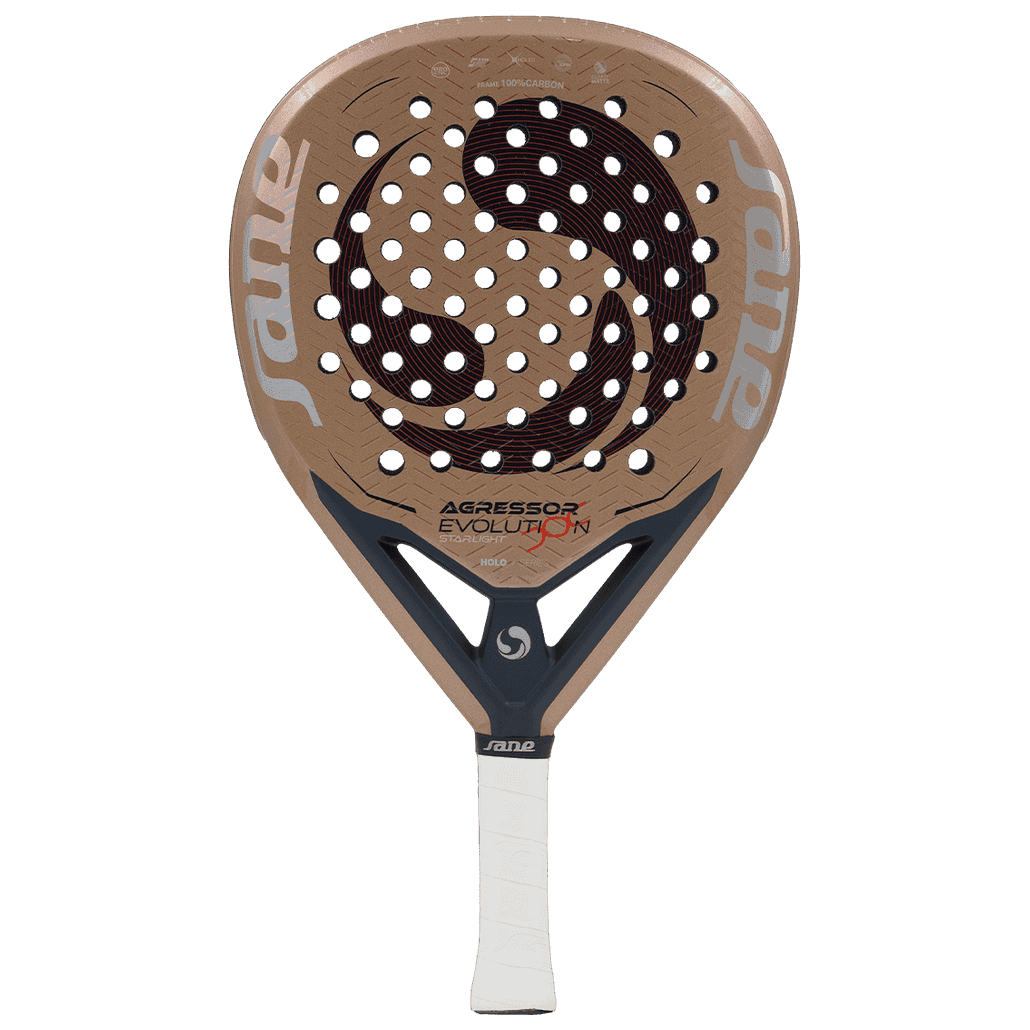
The Sane Agressor Evolution StarLight 2026 is a quick, forgiving tear-shaped racket built around easy depth rather than brute-force finishing. Its very high ball exit and broad usable hitting area give it a notably accessible response.
I see it as a racket for the intermediate player who wants help from the baseline without moving into a soft, vague feel. It does not demand a huge swing to send the ball deep, but it also will not turn every short ball into a winner.
Technical analysis
Shape & balance
The tear shape puts this Sane in a middle ground between a round control racket and a more demanding diamond. The balance feels mobile rather than head-heavy, which fits its strong maneuverability rating: I would expect it to come through quickly in fast exchanges and be easy to reset after a defensive block.
Its standout technical trait is the sweet spot. The hitting area is unusually generous on paper, and that should matter most on stretched off-the-wall shots, rushed volleys, and lobs contacted slightly above or below center. You get more margin than with a compact, attack-first racket.
That forgiveness has a trade-off. Players who rely on a very head-heavy racket to add mass through the smash may find the Agressor Evolution StarLight a little too neutral. It rewards clean acceleration, but it is not built to feel like a hammer.
Materials & construction
The faces use NanoGraf, a fiberglass construction reinforced with graphene, paired with the Pro Ctrl core. That combination explains the medium feel: there should be enough flex to provide easy rebound, without the disconnected sensation that some very soft fiberglass rackets can produce.
Ball exit is clearly the priority. On slower swings, the racket should still return a useful amount of depth, particularly in defensive situations where you cannot fully load the shot. I would not expect the same crisp, dry contact or sharp directional feedback of a hard 12K or 18K carbon face, though. Touch players who like to feel the ball sit on the face may want a firmer response.
On-court feel
Baseline play
From the baseline, this is where I expect the racket to be most comfortable. The high rebound helps get defensive lobs up and deep without forcing the arm, and the large sweet spot should make wall exits less punishing when contact is not clean.
It should also be useful for low-driven lobs and controlled counterattacks. I would not overhit with it. The easy response means a compact swing is often enough, while a full, flat acceleration can make depth harder to manage until you adapt.
At the net
At the net, the medium balance should keep the racket fast in the hand. Quick blocks, short volleys, and changes of direction are likely to be its better weapons than heavy finishing volleys. The face should offer enough output to keep the ball moving through the court even when you are late.
The limitation is bite. NanoGraf fiberglass is more likely to favor comfort and rebound than a hard carbon surface that really grabs the ball. I would not choose this racket specifically for cutting aggressive drop shots or producing maximum spin on every volley.
Bandeja and víbora
The maneuverability should help on the bandeja, especially when you need to stay compact and prioritize placement. The medium response ought to give a reliable ball flight without feeling excessively stiff overhead.
For the víbora, it will be more about technique than racket assistance. It can move quickly through the swing, but the moderate power profile means you need to create your own speed and slice if you want the ball to stay low and skid.
Conclusion
I would look at the Agressor Evolution StarLight 2026 if I wanted easy ball exit, a wide sweet spot, and a racket that remains quick during defensive and net exchanges. It makes most sense for intermediate players building consistency without giving up a lively response.
The trade-off is clear: this is not a specialist power racket, nor is it the firmest option for players who want maximum bite and a very precise carbon-style touch. Its strength is making difficult contacts more playable, not overpowering opponents with every smash.
Switch Intelligence
Be the first to share where you switched from.
Community reviews
Real feedback from players who used this racket.
Add your review
To submit your review, log in first. You can still read all approved community reviews below.
Add review


