

Osaka Vision Power 2026
A forgiving teardrop shape with a lively, springy response, giving newer players easy depth and enough punch to finish short balls.
Our Take
Shape
Tear
Weight
355 - 370 gr
Core
10-13 White Snap EVA foam
Faces
Glass fiber
Frame
30% carbon-reinforced glass fiber
What we like
- Effortless ball exit on blocks
- Broad sweet spot on defense
- Accessible overhead power and acceleration
What we don't
- Springy face reduces directional precision
- Delicate touch needs more adjustment
- Less crisp on cutting víboras
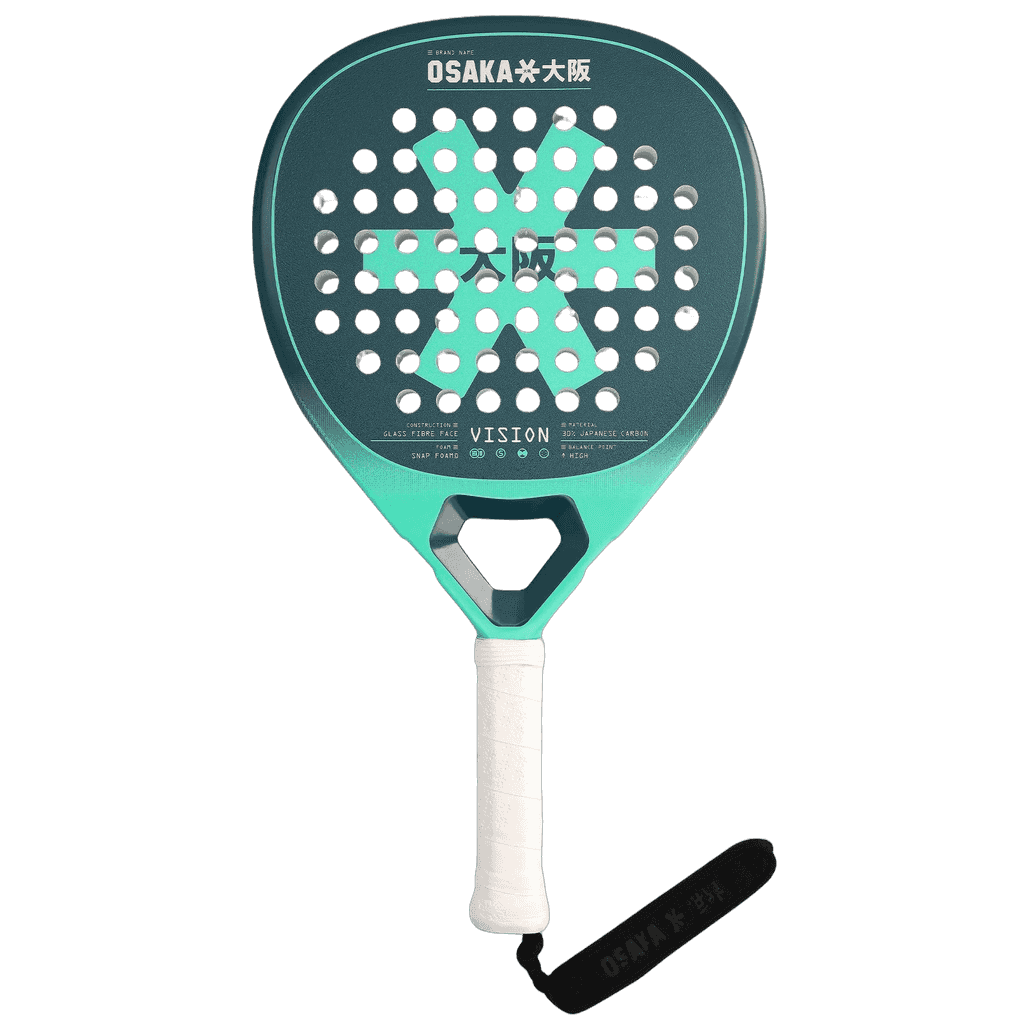
The Osaka Vision Power 2026 is a forgiving attacking racket built around easy ball exit rather than a hard, demanding response. It wants to help on shorter swings and defensive contacts, then give you enough shape and balance to finish points when you move forward.
I see it fitting developing intermediate players who want a racket that feels lively without becoming overly head-heavy. It is not a precision instrument for players who prefer a dry, low-output carbon face.
The teardrop shape gives it a fairly balanced identity: more attacking intent than a round racket, but without the abrupt handling of a full diamond.
Technical analysis
Shape & balance
The teardrop format places the sweet spot higher than a control-first racket, yet it remains broad enough to be useful during rushed defensive exchanges. With a high sweet spot, the Vision Power should reward clean overhead contact and firm volleys without punishing slight misses as severely as many power-oriented models.
Its balance does not look extreme, and that matters. I would expect enough head presence to make a smash and aggressive víbora feel purposeful, while still allowing the racket to come around quickly in hand fights at the net. Players who rely on a very head-light setup for fast wrist adjustments may still find it a little slower than a round control racket.
Materials & construction
Osaka uses a frame made from carbon-reinforced glass fiber, with glass fiber faces and a White Snap EVA Foam core. That construction points toward a softer, more elastic feel than a stiff 12K or 18K carbon racket.
The main characteristic here is rebound. The foam and fiberglass combination should return the ball with very little effort, especially on compact blocks, defensive lobs, and off-the-wall contacts where you do not have time to generate your own speed. That easy exit is useful, but it comes with a trade-off: players with fast, full swings may need to soften their hand to avoid sending the ball long.
On-court feel
Baseline play
From the baseline, I would expect the Vision Power to be one of those rackets that makes defense feel less laborious. A short block can still travel deep, and the broad sweet spot should reduce the number of dead contacts near the upper part of the face.
That said, it will not give the same locked-in directional control as a firmer carbon racket. On low-driven lobs and tight changes of direction, the lively response can work against you if your contact is loose. I would use a calmer swing and let the core do the work rather than trying to force every ball.
At the net
At the net, the forgiving face should help on reactive volleys and body shots. There is enough ball exit to keep blocks penetrating without having to overhit, which is useful in fast exchanges where the racket barely has time to accelerate.
The limitation is touch. Drop shots and very short chiquitas may take more adjustment because the face is eager to return energy. It is not a dead, absorbent racket that lets you kill the ball effortlessly.
Bandeja and víbora
The teardrop shape should make overheads accessible. A bandeja can be played with decent depth without needing a huge swing, and the racket should offer enough lift through the ball for a controlled attacking trajectory.
For a heavy, cutting víbora, though, it is not likely to feel as sharp or direct as a harder carbon model. The racket favors easy acceleration and comfortable contact over a brutally crisp response.
Conclusion
I would choose the Vision Power 2026 for its accessible power, broad sweet spot, and unusually easy ball exit. It makes sense for an intermediate player who wants more help in defense and enough attacking weight to finish a simple overhead.
The trade-off is precision at higher pace. Players who already generate plenty of speed and want a firmer, more exact response may find the fiberglass faces too springy.
Switch Intelligence
Be the first to share where you switched from.
Community reviews
Real feedback from players who used this racket.
Add your review
To submit your review, log in first. You can still read all approved community reviews below.
Add review


