

Sane Assassin Tactic 2026
A forgiving teardrop with a soft, lively response, giving developing players easy depth and a broad sweet spot without feeling cumbersome.
Our Take
Shape
Tear
Weight
355 - 375 gr
Touch
Medium-Soft
Core
PRO-Ctrl
Faces
Fiberglass
What we like
- Easy depth from baseline blocks
- Generous sweet spot on volleys
- Fast, forgiving defensive ball exit
What we don't
- Limited punch on full smashes
- Bouncy touch on drop shots
- Floats against heavy incoming pace
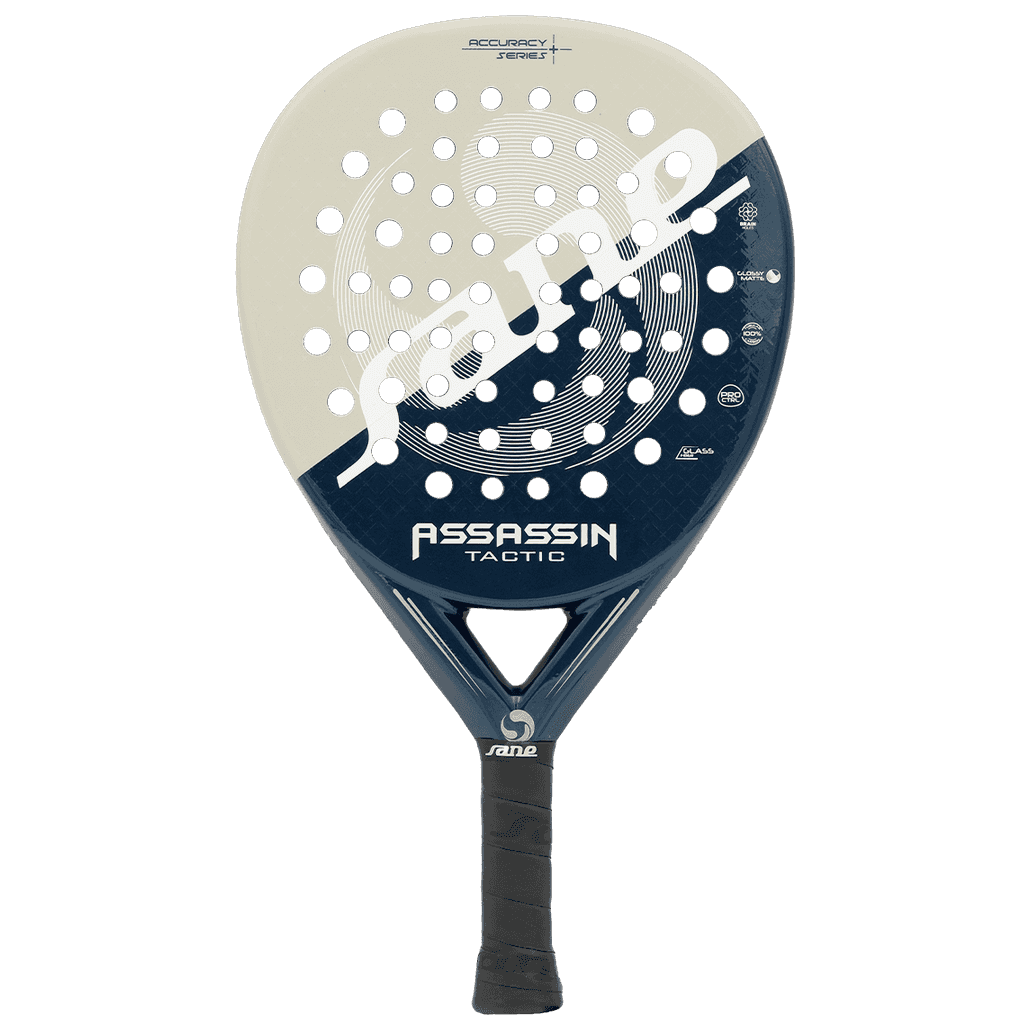
Sane Assassin Tactic 2026 is a forgiving, fast-releasing racket built around easy depth rather than brute-force finishing. Its tear shape gives it a more balanced attacking profile than a full diamond, while the medium-soft feel keeps the response accessible when the point gets messy.
I see it fitting players who want help from the racket at the baseline and on defensive transitions, but still want enough acceleration to take charge at the net.
The trade-off is clear: it will not give a heavy hitter the crisp, punishing contact of a hard-carbon power racket. You can finish with it, but it does more of the work through ball exit than through a brutally solid strike.
Technical analysis
Shape & balance
The tear format places the sweet spot high enough to support attacking shots without making the racket cumbersome in quick exchanges. With its very generous sweet spot, off-center contacts remain playable, particularly on rushed volleys and defensive blocks.
I would describe the balance as attack-friendly rather than head-heavy. It comes through the ball easily, but it does not feel like it is pulling the hand forward. That makes it a more manageable option for players who move frequently between baseline defense and net pressure.
The downside is that players who rely on maximum racket-head momentum may find the finish slightly too restrained. On a full-power smash, it rewards clean technique and acceleration, but it does not add the same dead-weight punch as a higher-balanced power model.
Materials & construction
The fiberglass faces and PRO-Ctrl core explain much of its behavior. Fiberglass tends to give the ball a more elastic contact, and that is exactly the direction this racket takes: lively, forgiving, and willing to return depth without demanding a huge swing.
Its rebound is a major part of the package. On slower balls, especially from deep in the court, the faces help the ball leave cleanly. That can be useful in defensive lobs and off-the-wall play, where you often need length more than outright speed.
Still, that elasticity has limits. Touch players who want a dry, highly connected feel for short drop shots may find the response a little bouncy. The ball does not sit on the face for long, so soft placements need a relaxed hand.
On-court feel
Baseline play
From the baseline, the Assassin Tactic feels cooperative. Blocks come off the face with little effort, and the racket helps produce depth even when I am late or defending below net height. It is particularly comfortable for sending a controlled defensive lob without having to overhit.
The large sweet spot also makes it less punishing during fast defensive exchanges. You do not need to find the center perfectly to keep the ball deep. That said, the high rebound means I would not call it the most precise racket for absorbing pace; against very hard hitters, I need firmer hands to stop the ball from floating.
At the net
At the net, maneuverability is one of its better traits. It changes direction quickly on reaction volleys, and the forgiving face helps when contact arrives close to the frame. I liked it most on compact blocks and controlled volleys aimed through the middle.
For aggressive bandeja and víbora shots, it offers enough speed to keep the ball low, but the finish is more about placement than raw penetration. Players who hit every overhead with maximum violence may want a firmer face and higher balance.
Conclusion
The Assassin Tactic suits intermediate players and regular club players who value easy ball exit, a broad sweet spot, and a racket that stays manageable across the court. It makes defensive padel less demanding and gives enough support at the net to build pressure.
What you give up is a sharper, more authoritative hitting sensation. It is not a racket for players chasing the hardest smash or the driest touch. Its strength is making the game easier without feeling passive.
Switch Intelligence
Be the first to share where you switched from.
Community reviews
Real feedback from players who used this racket.
Add your review
To submit your review, log in first. You can still read all approved community reviews below.
Add review


