

Softee Pro Master Evolution Yellow 2026
A soft, forgiving tear-shape with lively ball exit, giving developing players a generous platform from the baseline to the net.
Shape
Tear
Weight
355 - 375 gr
Core
EVA Soft S3 Foam
Faces
100% Fiberglass
What we like
- Easy depth on defensive blocks
- Large sweet spot aids pickups
- Quick handling in net exchanges
What we don't
- Springy response on fast blocks
- Lacks heavy penetrating volleys
- Limited bite on víboras
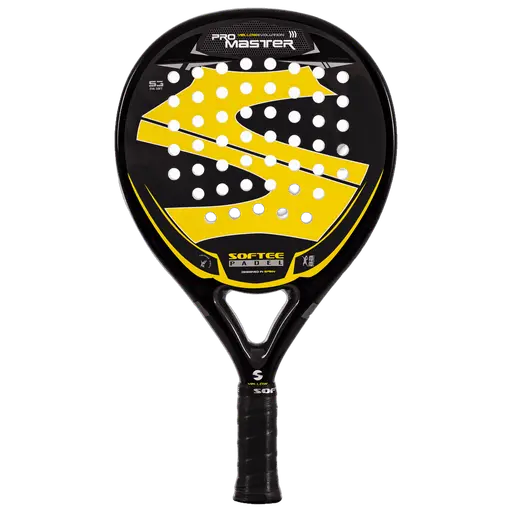
The Softee Pro Master Evolution Yellow 2026 is a forgiving, easy-launching racket built around comfort and ball exit rather than brute force. Its character is clear: it helps me get depth without having to swing flat out.
I see it making the most sense for developing and intermediate players who spend plenty of time defending, blocking, and rebuilding points. It does not demand a perfectly timed strike to return a useful ball.
That generosity comes with a limit. This is not a hard-hitting attacking racket for players who want a dry, explosive response on every overhead.
Technical analysis
Shape & balance
The tear shape gives this racket a fairly broad working area while keeping enough mass toward the upper half to help on attacking shots. With its very large sweet spot, I expect fewer completely dead contacts than with a more demanding diamond model, particularly on hurried volleys or off-the-wall pickups.
It should feel quick enough through preparation and direction changes, rather than cumbersome at the net. Still, the balance is unlikely to provide the heavy, head-driven finish that stronger hitters get from a clearly head-heavy power racket. You can accelerate it easily; you do not get much free punishment from it.
Materials & construction
The faces use 100% fiberglass, paired with an EVA Soft S3 core. That is a comfort-focused construction, and it explains the racket’s strong rebound and accessible ball exit. On slower defensive shots, I would expect the face to do a lot of the work, helping the ball leave the racket with less effort from my arm.
The trade-off is a softer, more elastic response rather than a crisp one. Fiberglass does not give me the same immediate, sharp feedback as a carbon face, especially when I hit hard through the ball. Players who rely on a firm touch for aggressive volleys, fast víboras, or punchy flat smashes may find it a little too springy.
On-court feel
Baseline play
From the baseline, this should be one of the racket’s better areas. The soft construction and generous sweet spot make defensive blocks, controlled lobs, and off-the-wall returns less stressful. If I catch the ball slightly outside center, I still expect enough response to send it deep rather than leave a short sitter.
That high rebound can also require adjustment. On quick balls, especially when blocking a hard volley, I would need softer hands and a more compact face angle. Otherwise, the racket may send the ball longer than intended. Players who prefer to absorb pace with a firmer racket will not get that planted, muted sensation here.
At the net
At the net, maneuverability should be a real advantage. I would be comfortable using it for fast exchanges, backhand blocks, and touch volleys where getting the racket into position matters more than forcing outright speed.
Its limitation appears when I want to finish through the court. The racket should place a volley well and provide easy depth, but it is not built to make every contact heavy. To hit a truly penetrating volley, I would still need clean timing and active acceleration.
Bandeja and víbora
The softer response should help me keep a bandeja deep without overhitting it. There is useful tolerance when contact is not perfect, which matters after chasing a lob or striking from an awkward body position.
For the víbora, though, I would not expect the same hard, biting exit that a firmer carbon racket produces. It can move the ball, but it is more about continuity and placement than overwhelming the opponent.
Conclusion
I would choose this racket for comfort, forgiveness, and easy depth. It suits players who want help in defense and a racket that stays manageable during quick net exchanges.
The main trade-off is attacking authority. The Pro Master Evolution Yellow can support an offensive point, but it does not deliver the dry response, heavy volley, or explosive smash that advanced power-oriented players may want.
Switch Intelligence
Be the first to share where you switched from.
Community reviews
Real feedback from players who used this racket.
Add your review
To submit your review, log in first. You can still read all approved community reviews below.
Add review


