

Softee Phantom 2026
A soft, forgiving teardrop built for easy ball exit and calm control, giving newer players room to defend, reset, and learn the net.
Shape
Tear
Weight
355 - 365 gr
Touch
Soft
Core
EVA Soft
Faces
Fiberglass
Frame
Fiberglass
What we like
- Easy depth from compact swings
- Forgiving sweet spot off-the-wall
- Quick reflex blocks at net
What we don't
- Springy response reduces fine control
- Lacks heavy attacking volley penetration
- Limited bite on fast víboras
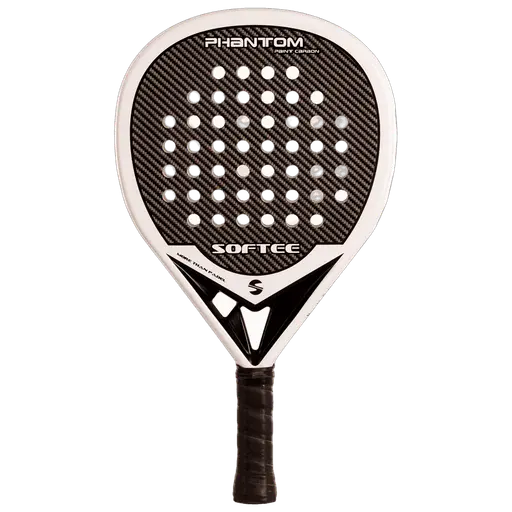
Softee Phantom 2026 is a forgiving, easy-going racket built around fast ball exit rather than brute-force hitting. Its tear shape gives it enough attacking intent to avoid feeling purely defensive, but the overall character remains soft, quick, and very accessible.
I see it fitting newer players, casual weekly players, and intermediates who want help getting depth without swinging flat out. Players who generate their own pace and want a firmer, more surgical response will find its limits sooner.
Technical analysis
Shape & balance
The tear profile places the sweet spot higher than a round racket without pushing it all the way toward a demanding, head-heavy setup. That matters in ordinary points: I can get the racket through quickly on defensive blocks, react comfortably at the net, and still find some extra leverage on overheads.
Its balance feels manageable rather than aggressive. The large sweet spot should make contact forgiving when I am late or stretched, especially on off-the-wall balls where the contact point is rarely clean. The trade-off is that it does not bring the mass or firmness that makes a racket feel especially imposing through the ball.
Materials & construction
The fiberglass frame and faces, combined with an EVA Soft core, explain much of the Phantom’s behavior. This is a soft feel racket with noticeable compression at impact. The ball stays on the face a touch longer, and the racket gives plenty back without demanding a hard swing.
That easy rebound is useful, but it also limits precision at higher speeds. When I really accelerate a volley or try to drive a low ball hard through the middle, the response can feel a little springy rather than sharply direct. Players who like a crisp carbon face and immediate feedback will probably find it too muted.
On-court feel
Baseline play
From the baseline, the Phantom is very friendly. Its ball exit helps on defensive lobs, blocked returns, and shots after the glass when I do not have time to build a full swing. I can play with compact preparation and still get reasonable depth, which is one of this racket’s strongest traits.
Control is good in the practical sense: it helps me keep the ball in play. Fine control is less impressive. On delicate drop shots or low-driven lobs, I need to soften my hand because the core can add more rebound than expected. It is forgiving, not especially precise.
At the net
Quick hands suit this racket. The maneuverable balance makes it comfortable in fast exchanges, and the broad sweet spot helps on reflex blocks when the ball arrives into my body. I also liked the ease of playing a chiquita after a short ball; it does not require much effort to send the ball low.
Hard attacking volleys are less convincing. The Phantom can place them well, but it does not produce the heavy, penetrating contact of a stiffer racket. If my net game depends on finishing points through sheer pace, I would want more firmness in the faces.
Bandeja and víbora
The softer response makes the bandeja straightforward to manage. I can prioritize height, depth, and margin without feeling that the racket is fighting my swing. It is also forgiving when I catch the ball slightly outside the center.
A fast víbora is harder to load with real bite. The racket will send the ball over reliably, but it does not reward an aggressive wrist snap with the same sharp output as a firmer, more head-heavy model.
Conclusion
I would choose the Phantom for comfort, easy depth, and a generous response in defense. It makes padel simpler when contact is imperfect and helps players build confidence from the baseline through to the net.
The trade-off is clear: power is available, but it is not crushing, and the soft construction gives up some accuracy when the pace rises. Advanced players looking for a hard, compact response on volleys, víboras, and smashes will likely outgrow it.
Switch Intelligence
Be the first to share where you switched from.
Community reviews
Real feedback from players who used this racket.
Add your review
To submit your review, log in first. You can still read all approved community reviews below.
Add review


