

Siux Pegasus 3 2025
A teardrop built for forceful attacking play, with enough composure at the baseline to keep hard-hitters from feeling stranded.
Shape
Tear
Weight
365 - 375 gr
Touch
Medium-Hard
Core
EVA foam
Faces
12K carbon
Frame
12K carbon tubular
What we like
- Authoritative volleys through the ball
- Stable blocks in off-the-wall play
- Crisp, low *víbora* response
What we don't
- Slower handling on low defenses
- Late contacts lose smash power
- Firm face exposes heavy touch
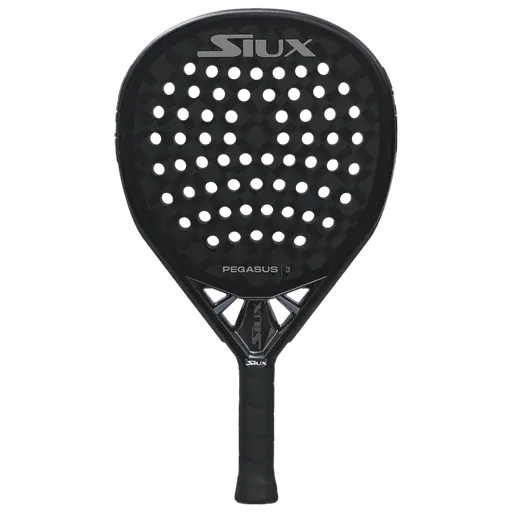
Siux Pegasus 3 2025 is an attacking racket with enough control to keep a composed player from feeling trapped by its power. It plays firm, direct, and most at home when I am taking time away at the net or finishing above shoulder height.
The tear shape gives it a more usable center than a full diamond racket, and the medium balance still gives the head some presence. This is not a passive, soft-touch option for players who want the racket to do the defensive work.
Its medium-hard feel suits players who hit through the ball. Clean technique gets rewarded; late contact does not.
Technical analysis
Shape & balance
The tear mold gives the Pegasus 3 a sensible blend of attack and control. I found the sweet spot reasonably broad for an offensively minded racket, especially compared with more demanding high-balance diamond models. That helps on volleys and controlled overheads, where I can accelerate without feeling that every contact needs to be absolutely central.
Still, the racket carries noticeable inertia through the stroke, which is useful for making the ball travel heavily but less helpful during rushed defensive exchanges. Fast hand changes and reactive blocks at the body require more preparation than with a head-light racket.
Materials & construction
Siux uses 12K carbon in both the faces and tubular frame, paired with an EVA core. The result is a firm, stable response rather than a springy or cushioned one. I get a clean sense of where the ball meets the face, and the racket does not feel vague when I am pressing a volley or driving a return.
Ball exit is good, but it is not automatic. The Pegasus 3 responds best when I add my own acceleration. Players who rely on a very soft core to lift defensive balls with minimal swing may find it a little dry. On the other hand, that firmer response makes direction easier to read on attacking shots.
On-court feel
Baseline play
From the baseline, I liked the control available on low-driven lobs and deeper returns. The racket stays stable through off-the-wall play, and the face does not wobble when I block a faster ball. If I set my feet, I can send a defensive lob with enough height and depth without overhitting it.
The trade-off is maneuverability. Under pressure, particularly on low balls near the feet, the racket can arrive a fraction late. It is not the racket I would choose for a player whose game is built around scrambling, absorbing pace, and resetting every point from defense.
At the net
This is where its character makes most sense. Volleys come off with authority, and the firm face lets me play through the ball rather than merely redirect it. I can close the racket face and hit a sharper angle without the response becoming unstable.
Touch shots need a quieter hand. A chiquita or drop shot can be played accurately, but the racket does not soften contact for me. It rewards feel and clean timing rather than disguising a heavy touch.
Bandeja and víbora
The Pegasus 3 feels particularly convincing on controlled overhead pressure. On a bandeja, the balance helps maintain depth without needing a huge swing. The firmer face also gives a clear, crisp response on a víbora, where I can accelerate through contact and keep the ball low after the bounce.
For outright smash power, it has plenty available, but I would not call it effortless. The racket transfers energy well when I hit cleanly; a poor contact high on the face loses more than it would with a softer, more forgiving model.
Conclusion
I would put the Pegasus 3 in the hands of an intermediate-to-advanced player who likes to build points into net pressure and has the technique to manage a firmer, medium-balance racket.
It brings serious pace to volleys, overheads, and the smash while retaining enough sweet spot to remain usable from the baseline. What it gives up is easy defense and soft touch. Players wanting quicker handling, gentler ball exit, or more help on late contacts should look elsewhere.
Switch Intelligence
Be the first to share where you switched from.
Community reviews
Real feedback from players who used this racket.
Add your review
To submit your review, log in first. You can still read all approved community reviews below.
Add review


