

Softee Rebounce Red 2026
A crisp tear-shape built to place the ball with intent, staying quick at the net and composed when contact is less than clean.
Our Take
Shape
Tear
Weight
355 - 370 gr
Touch
Medium-Hard
Core
Professional Black EVA
Faces
3K Carbon
What we like
- Quick, stable net blocks
- Broad sweet spot on volleys
- Deep spin-heavy bandejas and víboras
What we don't
- Little free ball exit
- Defensive depth needs acceleration
- Flat smashes lack easy pace
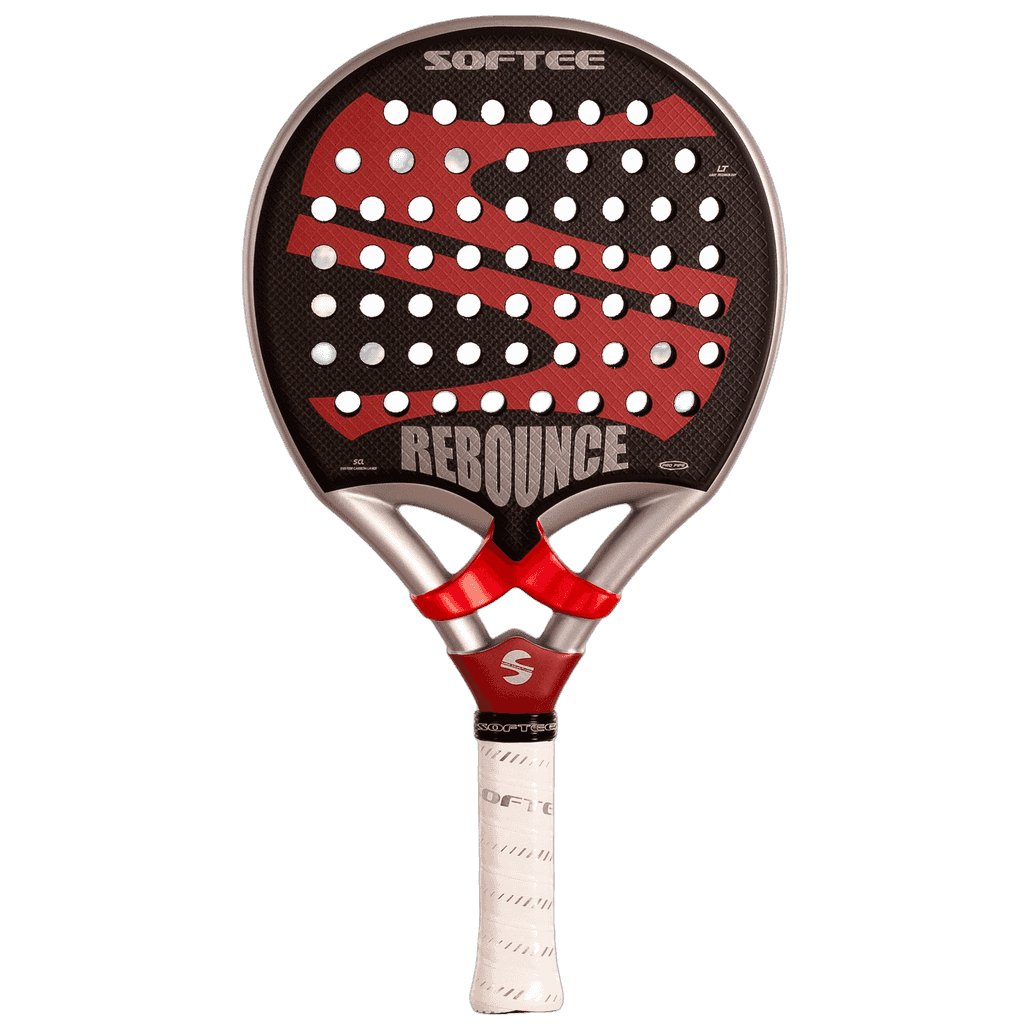
The Softee Rebounce Red 2026 is a control-led racket with a dry, direct response and enough forgiveness to keep fast exchanges from becoming messy. I see it as a racket for regular intermediate players who build points with placement, quick hands, and reliable overheads rather than raw finishing power.
Its character is composed rather than explosive. It rewards clean acceleration, but it will not manufacture depth or speed when your contact is late.
Technical analysis
Shape & balance
The tear shape gives the Rebounce Red a useful middle ground between a round control racket and a more attacking diamond. Its balance feels close to even, so the head moves quickly through compact volleys, blocks, and reaction shots without feeling unstable.
That maneuverability is one of its stronger traits. I would be comfortable using it in quick exchanges at the net, where a slow head can make the difference between a firm block and a floating ball. The sweet spot also feels broad for this type of response: slight misses remain playable instead of dying immediately off the face.
Materials & construction
The Carbon 3K faces and Black EVA Profesional core produce a medium-hard feel that is crisp and fairly communicative. Contact is not plush. I can clearly feel whether I have caught the ball cleanly, especially on flatter shots and defensive blocks.
That firmer response helps with direction, but it does not give much free ball exit. From a static position, the racket asks me to accelerate through the ball if I want length. Players used to softer fiberglass faces may find the Rebounce Red initially a little dry, particularly when defending low balls after the glass.
The textured face also appears to contribute useful bite. It is not a gimmick surface that only works in warm-up; it gives the ball enough grip to shape overheads with confidence.
On-court feel
Baseline play
From the baseline, I like the predictability. On off-the-wall play, the racket stays stable and lets me guide the return rather than fight excess rebound. A defensive lob can be placed accurately when I prepare early, and blocks against a hard volley do not feel flimsy.
The trade-off is clear: lazy technique gets exposed. If I am stretched, late, or trying to lift the ball with only my wrist, the Rebounce Red will not rescue the shot with easy output. Low-driven lobs and flat defensive returns need a full enough swing and committed follow-through.
At the net
This is where the racket makes most sense to me. Fast volleys come off cleanly, and the manageable head lets me change direction late without the frame lagging behind. I found it particularly useful for firm blocks and controlled punch volleys, where I want depth without overhitting.
The large usable hitting area helps in crowded net exchanges. It is forgiving enough to keep pressure on even when contact drifts slightly away from center, though it remains a precision racket first, not a soft rebound machine.
Bandeja and víbora
The rough face and direct response suit a deep bandeja very well. I can load spin, keep the ball low after the bounce, and aim toward the side fence without feeling the racket twist at impact. The same applies to the víbora: it favors shape and placement over brute force.
A flat overhead can still be effective, but it needs good racket-head speed. This is not the racket I would choose for effortless winners from imperfect positions.
Conclusion
I would point regular intermediate and advanced control-oriented players toward the Rebounce Red, especially those who value quick handling, stable volleys, and dependable overhead placement. It has a clear preference for construction shots and active net play.
What you give up is free power. The smash is more about targeting space than producing automatic x3 pace, and defensive depth requires proper acceleration. If I want a crisp racket that tells me what happened at contact, that trade-off makes sense.
What other reviewers say
- AvisPadelfr
The review describes a crisp, medium-hard and highly communicative response, backed by a large sweet spot that keeps slight mishits usable. It excels in control, quick volleys and bandejas, while smashes are more about placement than effortless x3 power.
- PadelTestLabit
The test praises the rough face for deep bandejas and spin-heavy víboras, as well as a stable, agile head on volleys and blocks. Its dry response is precise but supplies little free ball exit, so defensive lobs and flat smashes demand proper acceleration and follow-through.
- PadelRacketReviews.comen
This review positions it as a functional, even-balanced hybrid with moderate power, reasonable comfort and enough forgiveness for regular play. It is not presented as a benchmark-level option, and its control score leaves room for players seeking finer precision.
Switch Intelligence
Be the first to share where you switched from.
Community reviews
Real feedback from players who used this racket.
Add your review
To submit your review, log in first. You can still read all approved community reviews below.
Add review


