

Tecnifibre Bomba Soft 2026
A soft diamond that makes attacking play accessible, with easy ball exit and a forgiving touch that keeps demanding arms at ease.
Shape
Diamond
Weight
355 gr
Touch
Soft
Core
Soft Foam
Faces
Fiberglass
What we like
- Easy depth on defensive lobs
- Arm-friendly soft vibration absorption
- Accessible smash and sliced *víbora* pace
What we don't
- Lively rebound sends volleys long
- Muted feedback reduces contact precision
- Less predictable in fast exchanges
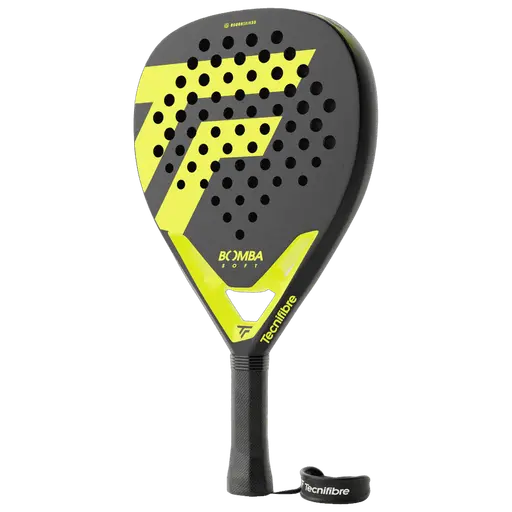
Tecnifibre Bomba Soft 2026 is a Diamond racket with a surprisingly forgiving personality. It wants to attack, especially overhead, but it does so with a soft, cushioned response rather than the hard, abrupt hit I expect from many diamond models.
I see it fitting intermediate players who want easier depth and more help finishing points without beating up their arm. It is not a precision instrument, though. The same lively ball exit that makes defense comfortable can make quick exchanges messy.
The Soft feel is the whole story here. It smooths out off-center contact, absorbs vibration well, and gives the racket a very accessible response from the first session.
Technical analysis
Shape & balance
The diamond shape places the sweet spot higher than on a round racket, so the Bomba Soft naturally favors attacking preparation. On smashes, bandejas, and aggressive volleys, I can feel the head working with the swing rather than needing to force every bit of acceleration myself.
That said, this is not a stiff, demanding hammer. The sweet spot is fairly generous for its shape, which makes it more manageable in defense than many diamond rackets. I still would not recommend it to someone who wants a very head-light, quick-hand racket for constant reaction volleys at the net.
Materials & construction
The Fiberglass faces and Soft Foam core explain its easy rebound. Contact feels muted and comfortable, with a lot of ball exit even when I am not fully driving through the ball. That is useful on defensive lobs, blocks, and off-the-wall shots where a firmer carbon face might require more input.
Fiberglass also brings a clear compromise: feedback is less direct. Compared with the carbon-faced Bomba versions, this racket does not tell me as precisely where the ball met the face. The textured surface gives useful bite for slice, especially when shaping a víbora, but it will not create spin by itself if the technique is flat.
On-court feel
Baseline play
From the baseline, the Bomba Soft is comfortable and forgiving. I can get depth on defensive lobs without overhitting, and blocked balls come off the face easily. Players with a shorter swing will appreciate that assistance.
The downside appears when I need to place a low-driven lob or play a measured ball through a narrow gap. Its rebound can add more length than expected, particularly with a fresh ball or on a fast court. I had to soften my hands and use more open-face control than I would with a firmer racket.
At the net
The soft impact makes volleys pleasant on the arm, and the racket has enough stability to redirect a medium-paced ball. It works well for deeper control volleys and for taking pace off with a block.
Fast, flat exchanges are less convincing. Short volleys can jump off the face, and I found that the racket asks for clean touch rather than rewarding lazy hands. If your net game depends on very sharp, compact volleys placed close to the tape, a harder carbon face will usually be more predictable.
Smash
This is where the diamond profile makes the most sense. The Bomba Soft helps me accelerate through the ball and gives accessible power on a smash without requiring an overly violent swing. It also feels friendly on repeated overheads, which matters over a long match.
It is not a hard-hitting power racket. Players who generate a lot of speed and want a hard, direct response may find the soft face too damped. The racket helps create depth and pace, but it does not deliver the crisp, explosive finish of a firmer attacking model.
Conclusion
I would choose the Bomba Soft for comfortable attacking padel: players who like a diamond shape, want easy ball exit, and value arm comfort over ultra-direct feedback.
Its strengths are clear in defensive recovery, sliced overheads, and accessible smashes. The trade-off is precision. In fast volleys and flat exchanges, the lively response can send the ball longer than intended, so it rewards players who can regulate touch rather than simply punch every ball.
What other reviewers say
- PadelStandde
This test frames it as a comfortable, arm-friendly diamond with a soft response and enough mass to accelerate attacking shots. The trade-off is that players must supply more of the pace themselves, while precision trails the carbon-faced Bomba models.
- PadelTestLabfr
The analysis highlights exceptionally easy ball output, a soft impact, and useful grip for sliced bandejas and víboras, with the diamond shape helping on smashes. However, the damped feedback and lively rebound make short volleys and fast, flat exchanges harder to control.
Switch Intelligence
Be the first to share where you switched from.
Community reviews
Real feedback from players who used this racket.
Add your review
To submit your review, log in first. You can still read all approved community reviews below.
Add review


