

Bullpadel Vertex 05 Woman 2027 Delfi Brea
A nimble diamond with lively exit and enough composure to turn defensive lobs into assertive net pressure without compromising the baseline.
Our Take
Recommended retail price €295 From €280 at 2 stores
Updated on 18 Nov


Updated on 18 Nov (shipping cost not calculated)


Are you a store owner? Join our platform to be featured here.
Shape
Diamond
Weight
350 - 360 gr
Touch
Medium
Core
MultiEVA
Faces
Fibrix
Frame
Carbon
What we like
- Easy defensive depth generation
- Fast handling in net exchanges
- Deep *bandeja* and biting *víbora*
What we don't
- Lively exit reduces touch precision
- Off-center contacts lose direction
- Less absorbing on slow volleys
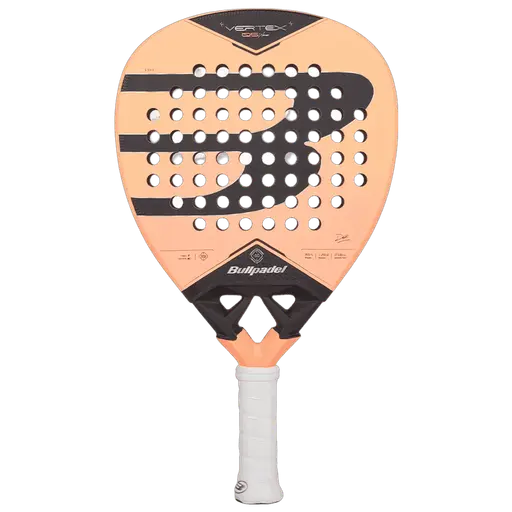
The Bullpadel Vertex 05 Woman 2027 Delfi Brea is an attacking racket that does not ask for brute force to feel lively. Its Diamond shape gives it a forward-looking personality, but the response is more accessible than many hard, demanding diamond rackets.
I found it quick through the air and notably springy on contact. The Medium feel sits in a useful middle ground: there is enough firmness to direct the ball, yet it does not punish slightly late defensive contacts as severely as a stiffer carbon-faced racket.
This is aimed at an intermediate-to-advanced player who builds points with pace, early volleys, and active overheads rather than relying solely on a huge smash.
Technical analysis
Shape & balance
The diamond format naturally favors shots played above net height, and I felt that most clearly when accelerating through volleys and overheads. It gives the racket a more offensive setup than a round control model, without feeling cumbersome during quick exchanges.
That said, this is not a laser-focused precision racket. The sweet spot is generous for its shape, but contact high toward the edges still loses some direction. Players who favor a very head-light racket for compact blocks and last-second adjustments may find it slightly more assertive than they want.
Materials & construction
Bullpadel uses a Carbon frame, Fibrix faces, and a MultiEVA core. On court, that combination translates into a responsive hit rather than a dry one. The faces provide a slightly elastic release, while the layered core keeps the response from becoming vague when I increased swing speed.
Ball exit is one of its clearest traits. Defensive shots do not need a huge swing to reach depth, and that can be a real advantage under pressure. The trade-off is that touch shots need a softer hand: on a short drop shot or chiquita, the racket can send the ball deeper than intended if I let the face do too much work.
On-court feel
Baseline play
From the baseline, I liked the help on off-the-wall balls and defensive lobs. The racket returns energy easily, so it is comfortable when I am stretched and need to get the ball back deep without a full preparation.
Control remains decent, but it comes from clean technique rather than a muted response. Flat blocks and low-driven lobs work well when I keep the face stable. If I try to guide the ball lazily, the lively rebound can make depth harder to manage.
At the net
At the net, the Vertex feels fast enough for exchanges that change direction quickly. It has enough stability to hit a firm volley through the middle, and enough maneuverability to react to body shots. I particularly enjoyed its response on punch volleys, where the ball leaves the face with little delay.
It is less convincing for players who want a very soft, absorbing touch in slow volley patterns. The racket prefers an active stroke and a clear target.
Bandeja and víbora
This is where the diamond shape makes most sense. My bandeja came off with easy depth, while the víbora had enough bite and speed to keep opponents pinned near the glass. The racket does not manufacture spin by itself, but it responds well when I brush the ball properly.
Conclusion
I would look at this racket if I wanted an offensively minded diamond model with a friendlier response than a hard power racket. It suits players who spend plenty of time at the net and want help generating depth from defense.
The compromise is clear: its lively ball exit can reduce touch precision, especially on slower shots, and it will not feel as calm or surgical as a round control racket. For a player who attacks with placement, volleys, and varied overheads rather than pure force, that trade-off makes sense.
Switch Intelligence
Be the first to share where you switched from.
Community reviews
Real feedback from players who used this racket.
Add your review
To submit your review, log in first. You can still read all approved community reviews below.
Add review


