

Middle Moon Atila 3.0 12K 2026
A firm diamond built to finish at the net, with a crisp hit and enough speed for sharp volleys—provided your defense is on time.
Shape
Diamond
Core
Power EVA
Faces
12K carbon fiber
Frame
2T Tubular (double carbon tubular)
What we like
- Forceful high-ball smashes
- Sharp, stable net volleys
- Direct spin on *víboras*
What we don't
- Small, high sweet spot
- Demanding on late defensive contact
- Restrained ball exit off glass
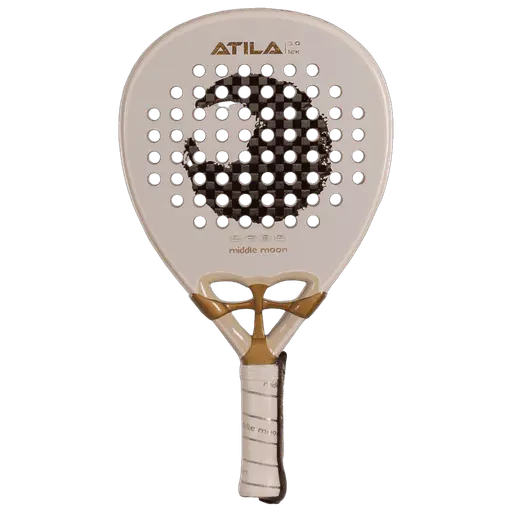
Middle Moon Atila 3.0 12K 2026 is a direct, attack-minded racket that wants the point to move forward. Its diamond shape and firm response make most sense in the hands of a player who is comfortable taking the ball early and finishing from the net.
I see it as a racket for imposing pace, not borrowing it. It rewards a committed swing and clean contact; late preparation, especially off the back wall, gets exposed quickly.
Technical analysis
Shape & balance
The diamond mold puts the usable sweet spot higher on the face, and that defines much of the Atila’s behavior. High contact feels lively and forceful, particularly on overheads, while lower or off-center contact loses some of that clean, connected response.
Despite its attacking geometry, it does not feel excessively slow through the air. In fast volley exchanges, I would expect enough maneuverability to react and redirect without feeling like the head is dragging behind the hand. Still, this is not a forgiving, head-light defensive racket. You need to arrive set.
Materials & construction
The 2T Tubular double-carbon frame, 12K carbon faces, and Power EVA core create a medium-hard feel with a crisp, fairly dry response. There is not much trampoline effect here. The ball comes off the face directly when you accelerate, but the racket does not add much free depth on compact defensive swings.
That firmer construction also explains why blocks can feel solid when the face is placed well. Miss the center, though, and the feedback is clearer than on a softer racket with a broader sweet spot. Players who like to feel the ball compress into the face may find it a little too abrupt.
On-court feel
Baseline play
From the baseline, the Atila asks for active footwork and a complete stroke. On defensive lobs and balls coming off the glass, it does not give much help if you are stretched or late. The upper sweet spot is particularly noticeable here: contact low on the face can leave the ball shorter than intended.
With time and space, I like the directness for low-driven lobs and firm counterattacks. But this is not the racket I would choose to make defense easier. Its ball exit is restrained, so players who rely on the racket to lift the ball will have to work harder.
At the net
At the net, its personality makes much more sense. Volleys come off with a sharp, stable response, and the racket is quick enough to handle rapid exchanges without becoming clumsy. I would use it to press through the middle, block firmly at the body, and accelerate short volleys when the opening appears.
The face also seems to offer enough bite for controlled drop shots, provided the touch is clean. It is more convincing on decisive contact than on soft, improvised touch play.
Bandeja and víbora
This is a strong area. The firm face gives a clean release on an aggressive bandeja, while the high sweet spot helps when contact is taken above shoulder height. On the víbora, the direct response and carbon face should let experienced players load spin without the racket feeling vague.
It will not hide poor timing, though. If contact drifts too low or too far behind the body, the shot loses both depth and direction.
Smash
The smash is where the Atila earns its attacking label. It transfers pace well on high balls and responds best when I commit to the acceleration rather than trying to flick the ball out with a short action. Flat smashes feel forceful, and there is enough firmness to keep the response direct rather than overly bouncy.
Conclusion
I would put the Atila 3.0 12K in the hands of an upper-intermediate or advanced player whose game is built around net pressure, overheads, and finishing opportunities. It has the speed for active volley play, but its real value is the authority it brings to the smash, bandeja, and víbora.
The trade-off is clear: its sweet spot is not especially generous, and defense requires more from the player. If your priority is easy ball exit, comfort on late contacts, or a softer response off the wall, this racket will feel demanding rather than helpful.
What other reviewers say
- PadelTestLabes
This test portrays it as a medium-hard attacking racket, delivering a crisp, direct response on smashes, blocks, and spin-heavy víboras or bandejas. In return, it needs player-generated pace in defense, has a small high sweet spot, and is unforgiving when preparation is late off the back wall.
- AvisPadelfr
The analysis highlights its finishing power on high balls and smashes, while finding it quick enough for fast volley exchanges. It reports a firm-leaning feel and a merely adequate—not notably large—sweet spot, positioning it for advanced attacking players.
Switch Intelligence
Be the first to share where you switched from.
Community reviews
Real feedback from players who used this racket.
Add your review
To submit your review, log in first. You can still read all approved community reviews below.
Add review


