

Munich Shadow Flex 2026
A round carbon racket with a broad, forgiving response, built to steer the point from defense and still put weight through the smash.
Shape
Round
Weight
360 - 375 gr
Core
Black EVA 13
Faces
100% 3D carbon fiber
Frame
100% carbon double tubular
What we like
- Large sweet spot on blocks
- Quick handling for defensive lobs
- Firm, precise volley response
What we don't
- Limited smash penetration
- Late swings lack easy depth
- Less kick on *víboras*
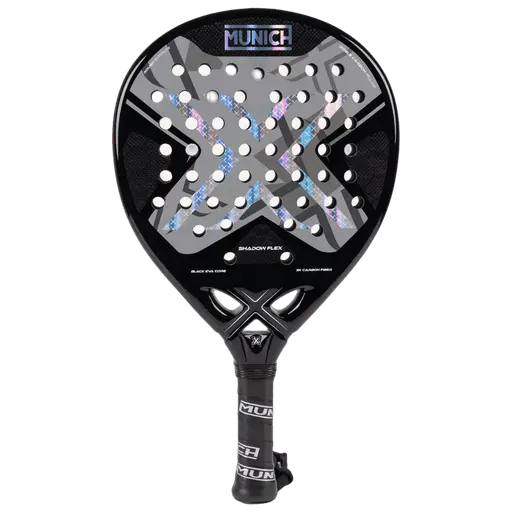
Munich Shadow Flex 2026 is a control-first racket with enough firmness and ball exit to avoid feeling passive. Its round shape and broad hitting area point it toward organized, placement-led padel rather than all-out attacking play.
I see it fitting the player who builds points patiently from the baseline, values a reliable block, and wants to move forward without suddenly carrying a demanding head-heavy racket.
It is not a smash specialist. You can finish with it, but its real strength is making the next ball uncomfortable for your opponents.
Technical analysis
Shape & balance
The round mold gives this racket a generous sweet spot, and that is the foundation of its 9.5-level control character. On off-center contact, I would expect less punishment than with a diamond or a more aggressive teardrop mold. That matters in fast exchanges, especially when you are defending hard volleys at body height or reacting late off the glass.
Its medium balance sits in a manageable middle area rather than pulling heavily toward the head. The racket should come through quickly on compact swings, which helps with defensive lobs, quick blocks, and changing direction at the net. I would not call it ultra-light in the hand, though. The carbon construction should still give it a stable, planted feel through contact.
Materials & construction
The 100% carbon double tubular frame and 100% 3D Carbon Fiber faces suggest a firm, stable structure rather than a soft, muted racket. That should give the Shadow Flex a direct response when I hit through the ball, particularly on controlled volleys and low-driven lobs.
Munich pairs that shell with a Black EVA 13 core. The listed rebound level suggests there is useful ball exit, but not the trampoline effect that can make soft rackets vague under pressure. I would expect a medium-to-firm feel: responsive enough to help from the back, yet controlled when I take pace off the ball.
The trade-off is comfort on lazy swings. This is not the sort of racket that will manufacture depth for me when I arrive late and simply stick the face out. It should reward clean contact and a more intentional stroke.
On-court feel
Baseline play
From the baseline, this is where I expect the Shadow Flex to make the most sense. The large sweet spot should make blocks predictable, while the controlled ball exit gives me room to play a high defensive lob without sending it long. In off-the-wall play, the maneuverability should help me get the racket into position early and guide the ball rather than fight the frame.
I would also trust it for chiquitas and slower changes of pace. The racket’s control bias should make it easier to keep those balls low and directed. What it will not do as well is provide effortless depth from a defensive, shortened swing; I still need to use my legs and finish the shot.
At the net
At the net, the Shadow Flex looks more precise than brutal. I would use it to build pressure with firm volleys into the feet, angle the ball away, and block hard exchanges without the racket twisting too much. The round format should inspire confidence when the ball arrives quickly or slightly outside my preferred contact point.
For bandejas and víboras, the quick handling should be useful, especially if I prioritize placement and a low trajectory. Heavy kick and outright penetration may be more limited than with a head-heavy attack racket. Players who rely on their overhead game to end points repeatedly may want more mass in the head and a harder, more explosive response.
Conclusion
I would choose the Shadow Flex for control-led intermediate and advanced players who want a carbon racket that remains accessible in defense. It should suit players who value consistency, quick hands, and a dependable sweet spot over raw finishing power.
The trade-off is clear: it is less suited to players who want their racket to do the work on the smash or produce easy depth from slow contact. In the right hands, though, it looks like a composed racket for winning points through placement rather than forcing them.
Switch Intelligence
Be the first to share where you switched from.
Community reviews
Real feedback from players who used this racket.
Add your review
To submit your review, log in first. You can still read all approved community reviews below.
Add review


