

Munich Spectra X 2026
A firm, diamond-shaped hitter built to finish high balls with authority, while demanding clean timing when the point turns defensive.
Our Take
Shape
Diamond
Weight
360 - 375 gr
Core
Black EVA Core 9
Faces
100% 6K carbon fiber
Frame
100% carbon double tubular
What we like
- Heavy, penetrating net volleys
- Decisive smash acceleration
- Deep, skidding bandejas
What we don't
- Reduced sweet spot forgiveness
- Demanding rushed defensive blocks
- Slower during quick exchanges
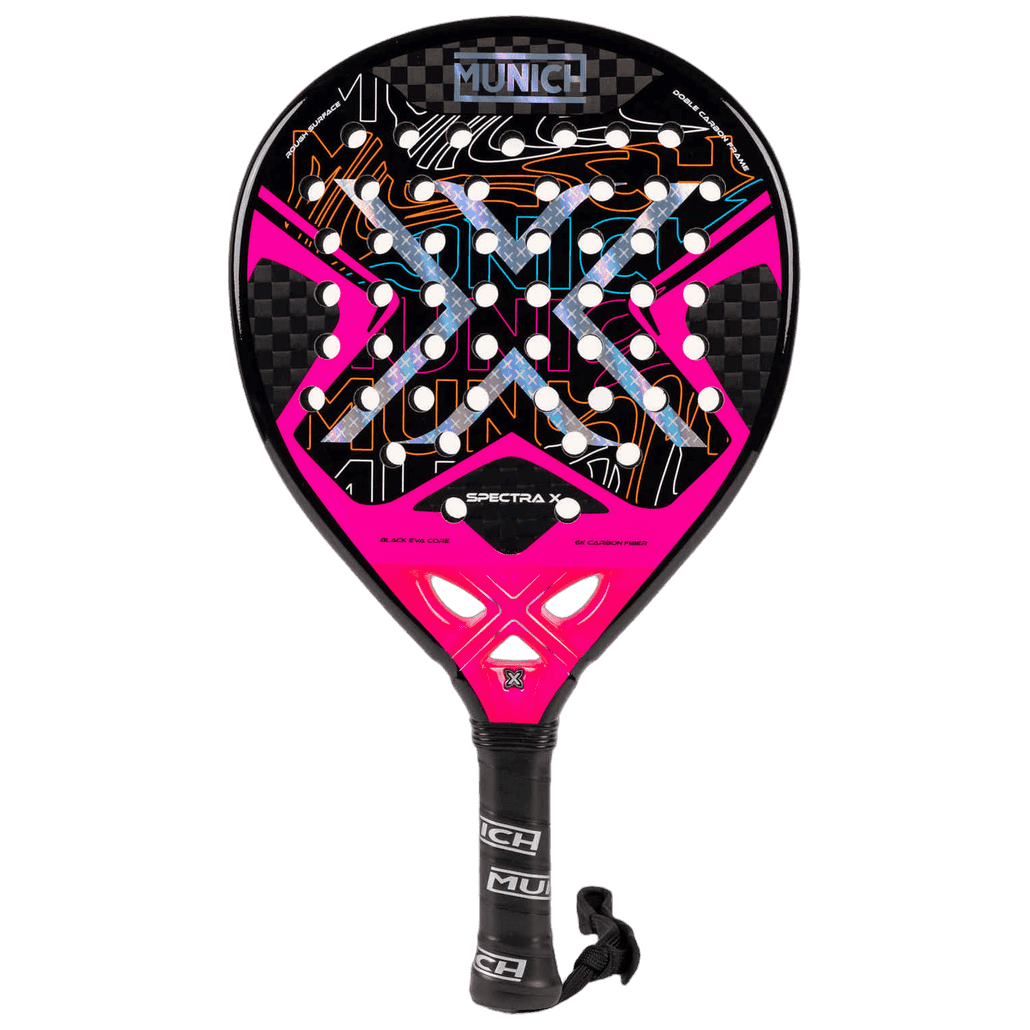
The Munich Spectra X 2026 is a direct, attack-first racket. Its diamond shape and high-power construction point it toward players who want to finish points rather than simply keep the ball in play.
I see it as a racket for an intermediate-advanced player with a confident overhead game. It asks for clean preparation and an active swing, but it should reward that effort with serious acceleration through the ball.
There is a trade-off, though. This is not the forgiving choice for slow defensive exchanges, late contacts, or players who depend on a large sweet spot to bail them out.
Technical analysis
Shape & balance
The diamond mold naturally puts more of the racket’s working area higher in the head, and the Spectra X is built around that offensive geometry. The balance should favor attacking shots, especially when I can get the racket moving early and strike above shoulder height.
That profile gives the racket more authority on volleys, overheads, and aggressive return shots, but it also makes it less quick than a round or head-light frame during rapid hand exchanges. The listed sweet spot is relatively limited, so I would not expect much forgiveness near the upper edges of the face. Clean contact matters.
At the baseline, that narrower effective hitting zone can make rushed blocks and off-the-wall play more demanding. Players with compact mechanics will manage it better than those who tend to reach late for the ball.
Materials & construction
Munich uses a 100% carbon double tubular frame, 6K carbon fiber faces, and a Black EVA Core 9 core. On paper, that is a firm, structurally stable layup rather than a soft, elastic setup built around easy ball exit.
The carbon face should give the Spectra X a more immediate response on driven shots. I would expect a firm impact sensation, with the racket responding best when I put energy into the ball rather than relying on the core to do all the work. That generally suits attacking volleys and fast overheads well.
What it is less likely to offer is the cushioned touch some players want for delicate drop shots or passive defensive lobs. The frame and face construction should keep the racket stable, but stability is not the same thing as softness.
On-court feel
Baseline play
From the back of the court, I would use the Spectra X with intent. It should be effective for low-driven lobs and firm returns that push opponents away from the net, particularly when I can step into the ball.
Passive defense is less appealing. The sweet spot does not suggest a racket that will make awkward contacts easy, and the diamond profile can feel slower when reacting to a fast body shot. I would want sound technique on the glass, especially when blocking low balls after the rebound.
At the net
This is where the racket’s character makes the most sense. The diamond profile and carbon build should give volleys a heavy, penetrating response, with enough firmness to keep the ball low when I punch through it.
Quick reflex blocks may require more hand strength than with a more maneuverable racket. Still, once I establish position at the net, the Spectra X should feel more comfortable pressing the point than absorbing pressure.
Bandeja and víbora
The Spectra X should suit players who hit their bandeja with purpose rather than simply using it to reset. The firmer construction should help send a deeper, more skidding ball when I accelerate through the shot.
A víbora also fits the racket’s profile, particularly for players who can generate their own racket-head speed. It will not create spin or placement by itself, though. Late contact will be exposed more clearly than with a softer, more forgiving face.
Conclusion
I would choose the Munich Spectra X 2026 for an attacking player who spends a lot of time at the net and wants a racket that supports decisive volleys, aggressive overheads, and a committed smash.
Its strengths come with a cost: less forgiveness, a smaller usable sweet spot, and less help during rushed defensive play. Players who value easy handling and soft touch over attacking weight will likely find it demanding.
For a player with solid mechanics and a proactive game, that demanding nature is part of the appeal.
Switch Intelligence
Be the first to share where you switched from.
Community reviews
Real feedback from players who used this racket.
Add your review
To submit your review, log in first. You can still read all approved community reviews below.
Add review


