

Munich Sky Edge 2026
A firm diamond built to finish from overhead, with enough composure at the baseline to keep aggressive players in the point.
Shape
Diamond
Weight
360 - 375 gr
Core
Black EVA 9
Faces
100% 3K carbon fiber
Frame
100% carbon double tubular
What we like
- Authoritative smash energy transfer
- Penetrating firm volley response
- Direct *víbora* and *bandeja* depth
What we don't
- Demanding high sweet spot
- Low defensive contact feels uncomfortable
- Firm faces limit drop-shot touch
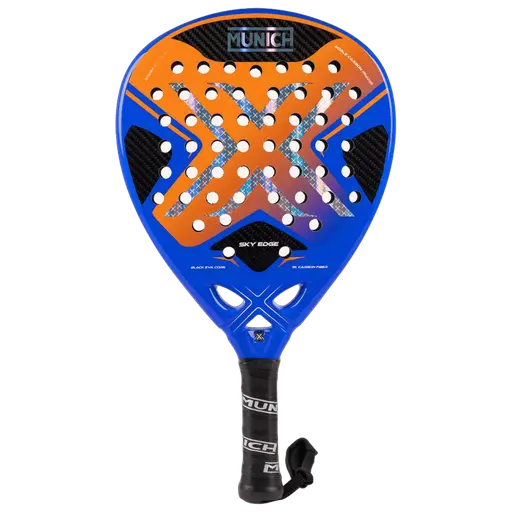
Munich Sky Edge 2026 is an attack-minded racket with a firm, direct personality. Its diamond shape and power-focused build point it toward players who want to press at the net and finish short balls rather than rely on passive ball exit from the baseline.
I see it as a racket for an intermediate-to-advanced player with a reasonably complete overhead game. It can produce a heavy ball, but it does not hide late preparation or loose contact.
The control rating is respectable, yet this is not a soft, forgiving control racket. You get precision by committing to the shot and finding the central hitting area.
Technical analysis
Shape & balance
The diamond format places the usable hitting zone higher in the racket and gives the Sky Edge its offensive bias. That geometry helps when I am accelerating through a volley, bandeja, or smash, because the racket wants to move through the ball with authority.
The trade-off is a more demanding sweet spot. It is not tiny, but it is less generous than what I would expect from a round racket. Defensive blocks hit toward the upper edge can feel firmer and less predictable, especially when I am rushed after a deep return or an awkward off-the-wall ball.
Maneuverability should be adequate rather than especially quick. At the net, I would not call it sluggish, but fast hand exchanges require clean preparation. Players who prefer a head-light racket for constant wrist work may find it a little more work than they want.
Materials & construction
Munich uses a 100% carbon double-tubular frame, 3K carbon faces, and a Black EVA 9 core. That is a sensible construction for a racket built around impact stability and a firmer response rather than a soft, springy touch.
The carbon faces should give the ball a crisp release when I accelerate properly. On aggressive volleys and flat overheads, that firmer contact helps keep the racket stable instead of flexing too much through impact. The core also supports a firm, direct feel: there is enough rebound to avoid a dead response, but it will not provide effortless depth when my swing is short.
On-court feel
Baseline play
From the baseline, the Sky Edge rewards active defense. When I set my feet and drive through a defensive lob or a controlled return after the glass, it should produce good depth without feeling vague. The response looks strong enough to send a low-driven lob through the middle with purpose.
That said, it is not the racket I would choose for lazy defensive recovery. The firmer build asks me to supply the touch on slow balls, and the higher sweet spot makes low contact less comfortable. A softer racket would be easier for simply absorbing pace and floating the ball back.
At the net
This is where the racket makes the most sense. Firm volleys, punch blocks, and aggressive chiquitas should come off with a clean, penetrating trajectory. I particularly like this type of response for taking time away from opponents rather than trying to manufacture excessive spin.
Touch shots need more attention. A short drop shot is possible, but the firm faces do not naturally cushion the ball. I would rather use it to play a decisive volley or a controlled block than expect it to do delicate work for me.
Bandeja and víbora
The Sky Edge’s format should suit players who hit overheads with intent. A víbora can benefit from the direct carbon response, while a firm bandeja should carry good depth without requiring a huge swing.
Its smash is the clearer strength. With clean technique and full acceleration, the racket should transfer energy very efficiently. Players still developing timing overhead will not get that benefit consistently; mishits higher on the face will quickly remind them that this is a diamond racket.
Conclusion
I would put the Munich Sky Edge 2026 in the hands of a player who wants more authority at the net and has enough technique to handle a firmer, less forgiving contact. It suits an aggressive game built around volleys, overhead pressure, and finishing opportunities.
The trade-off is comfort. It does not offer the easiest defensive response, the broadest sweet spot, or the softest touch on slow balls. If I value quick handling and automatic help from the back of the court, I would look elsewhere.
Switch Intelligence
Be the first to share where you switched from.
Community reviews
Real feedback from players who used this racket.
Add your review
To submit your review, log in first. You can still read all approved community reviews below.
Add review


