

Dunlop FX Team 2026
A diamond racket built for sharp net exchanges and committed attacking swings, asking you to generate the pace when defending deep.
Shape
Diamond
Weight
360 - 370 gr
Touch
Medium
Core
Pro EVA
Faces
Carbon
Frame
Premium carbon
What we like
- Quick handling in volley exchanges
- Firm, stable attacking volley response
- Penetrating bandejas and víboras
What we don't
- Small sweet spot punishes mishits
- Limited ball exit on defense
- Passive blocks lack baseline depth
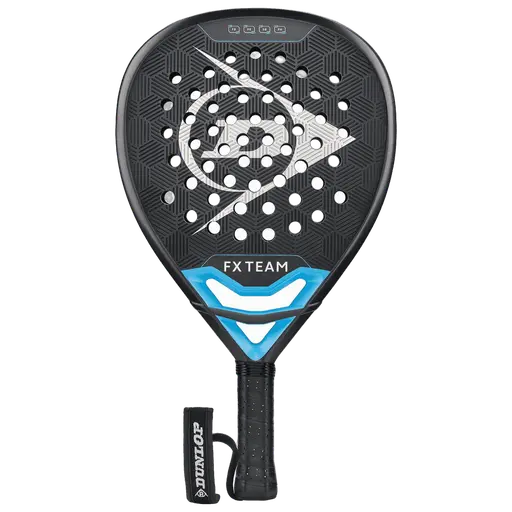
Dunlop FX Team 2026 is an attacking racket with a fairly direct, medium-response character. Its diamond shape puts the emphasis on finishing points and pressing at the net, but it is not an uncontrollable cannon.
I found it more manageable than many diamond-shaped rackets. That does not make it forgiving everywhere, though: the smaller central sweet spot asks for clean contact, especially when defending under pressure.
The feel sits firmly in the medium range. There is enough firmness to hit through the ball, without the dry, unforgiving response that can make a racket tiring in longer matches.
Technical analysis
Shape & balance
The diamond profile concentrates the useful hitting area higher in the racket, which shows up most clearly on overheads and attacking volleys. The medium balance keeps it from feeling head-heavy, so quick exchanges do not become a struggle.
That said, the sweet spot is not its strongest trait. Mishits near the upper edges lose pace and direction more quickly than they would with a round racket. Players who prepare late or rely on defensive blocks with minimal swing will notice that limitation.
Materials & construction
Dunlop uses a premium carbon frame, carbon faces, and a Pro EVA core. The construction gives the racket a stable response when I accelerate through the ball. It does not feel overly springy; instead, it rewards a committed swing with a controlled, firmer strike.
Ball exit is moderate rather than automatic. That is an important distinction. The racket can produce serious power when I supply racket-head speed, but it does not launch slow defensive balls for me. In cold conditions or on low-contact shots, it asks for active technique.
On-court feel
Baseline play
From the baseline, the FX Team is more capable than its diamond silhouette suggests. On difficult balls after the wall, it stays reasonably quick through the swing and does not feel clumsy while resetting the point. I can also play a defensive lob with good length when I get underneath the ball properly.
Still, this is not a racket for passive defense. Short preparation and a soft block can leave the ball sitting up because the response does not provide much free depth. I had better results driving through the ball or using a more deliberate lift on lobs.
At the net
This is where the racket makes the most sense. In fast volley exchanges, it reacts quickly enough to keep the racket in front and punch the ball through the middle. The firmer carbon response helps me flatten a volley without the face wobbling, particularly when I want to take time away from the opposing pair.
Touch shots require more restraint. A short chiquita or drop volley can be played cleanly, but the diamond shape does not give me the same easy placement as a control-focused round racket. It prefers decisive volleys over delicate improvisation.
Bandeja and víbora
The racket works well for an aggressive bandeja and a more penetrating víbora. The diamond shape helps carry the ball forward, while the medium core keeps the contact predictable enough to direct it toward the fence or into the body.
On a smash, there is real finishing potential, especially for players who generate their own speed. The trade-off is clear: it rewards good mechanics, but it will not rescue a lazy swing or an off-center contact.
Conclusion
I would point the FX Team toward intermediate-to-advanced players who want an offensive racket that remains quick enough for active net play. It suits someone who likes to volley aggressively, attack overheads, and create pace rather than wait for the racket to do it.
The compromise is defensive assistance. Ball exit is not especially generous, and the sweet spot is less forgiving than the power rating might suggest. If your game depends on effortless depth from the baseline, look elsewhere; if you can generate your own pace and want a sharper attacking response, this one has a clear purpose.
What other reviewers say
- Padel Ibéricoes
The review finds it easy to handle in attack, especially at the net where it reacts quickly in fast volley exchanges. It also helps with difficult defensive balls from the back, but players need to supply more of their own pace because ball output is somewhat lower.
Switch Intelligence
Be the first to share where you switched from.
Community reviews
Real feedback from players who used this racket.
Add your review
To submit your review, log in first. You can still read all approved community reviews below.
Add review


