

Munich Hyper Vibe 2026
A hard-hitting diamond for decisive overheads, pairing a demanding sweet spot with enough control to build the point before finishing.
Shape
Diamond
Weight
360 - 375 gr
Core
Black EVA 9
Faces
100% 6K Carbon Fiber
Frame
100% carbon double tubular
What we like
- Authoritative smash acceleration
- Weighted attacking volleys
- Penetrating *bandeja* and *víbora*
What we don't
- Reduced sweet spot forgiveness
- Demanding late defensive blocks
- Delicate touch shots run deep
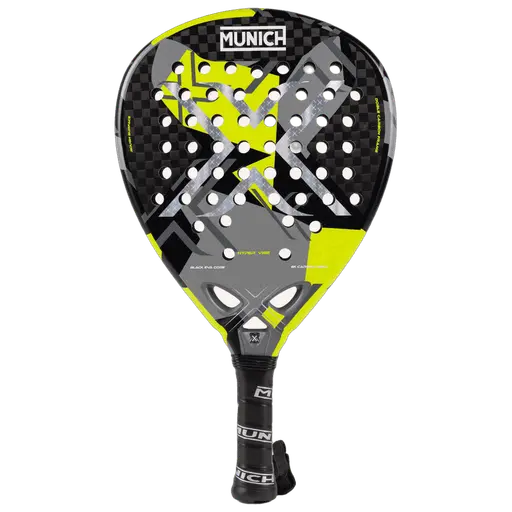
The Munich Hyper Vibe 2026 is an attack-first racket with a clear point of view: get the ball moving through the court, especially from above the shoulder. Its diamond shape and power-oriented build make it a racket for players who want to finish points rather than simply keep them alive.
I’d put it in the hands of an intermediate-to-advanced player with an assertive game and a reasonably clean overhead technique. It is not a forgiving, easygoing defensive racket.
There is useful control here, but it comes from committing to the shot and finding the center consistently—not from a huge sweet spot or a soft, automatic response.
Technical analysis
Shape & balance
The diamond mold places the usable hitting area higher in the racket, and the Hyper Vibe feels built around that offensive geometry. Even with a medium balance, the diamond head gives the racket more leverage through a smash and more weight behind aggressive volleys.
That same setup asks more of the player in rushed exchanges. The listed sweet spot is not especially generous, so contact outside the upper-middle zone can feel less clean and less predictable. If your defensive game depends on late wristy blocks or casual off-the-wall recoveries, this is not the most accommodating shape.
Materials & construction
Munich uses a 100% carbon double tubular frame, 6K carbon fiber faces, and a Black EVA 9 core. On paper, that is a firm, direct construction rather than a plush one, and it suits the racket’s attacking purpose.
The carbon face should give a more immediate response when I accelerate through the ball. There is enough rebound to avoid the dead sensation some stiff rackets can have, but I would not expect the core to provide much free ball exit on slow, defensive swings. This is a racket that rewards active technique. Soft hands alone will not make it do the work.
On-court feel
Baseline play
From the baseline, I would use the Hyper Vibe to play with depth and intention rather than trying to absorb pace. Low-driven lobs and firmer returns make sense because the racket’s response favors a committed strike. When contact is centered, the ball should leave with good penetration.
The trade-off is comfort. On defensive lobs, especially when I am late or stretched after the glass, the diamond head can feel slower to position. Blocks are workable, but they need a stable racket face; this is not a racket that masks loose preparation.
At the net
At the net, the Hyper Vibe’s character makes more sense. The diamond head helps me drive volleys through the middle and put pressure on opponents’ feet. It should also feel stable enough when redirecting a faster ball, provided I meet it in front.
Touch shots are less natural. A soft drop shot or chiquita needs a measured hand because the firmer carbon construction can send the ball deeper than intended if I leave the face open. I would not choose it primarily for finesse play.
Bandeja and víbora
The racket should be strongest on assertive overheads. A bandeja can be played with depth and weight, while a more accelerated víbora should benefit from the diamond-shape leverage and direct face response.
It will not create spin by itself, though. Players who rely on a very textured, grippy face for exaggerated sidespin may find the bite more conventional than spectacular.
Conclusion
I see the Hyper Vibe 2026 as a racket for players who want a firm, offensive response and are comfortable playing forward. Its main strengths are attacking volleys, aggressive overheads, and finishing a smash with authority.
The compromise is clear: less forgiveness in defense, a smaller effective sweet spot, and less help on delicate touch shots. Players who spend most of the match constructing points from the baseline may want a more maneuverable, softer option.
Switch Intelligence
Be the first to share where you switched from.
Community reviews
Real feedback from players who used this racket.
Add your review
To submit your review, log in first. You can still read all approved community reviews below.
Add review


