

Nox ML10 Pro Cup Rough 2027 Miguel Lamperti
A soft, forgiving round racket that keeps the point calm from the baseline, with enough bite to finish a clean overhead.
Our Take
Shape
Round
Weight
360 - 375 gr
Touch
Soft
Core
HR3 EVA
Faces
Silver Fiberglass
Frame
Carbon
What we like
- Forgiving broad sweet spot
- Easy depth on defensive lobs
- Controlled *bandeja* placement and depth
What we don't
- Limited free power on smashes
- Fast blocks can overtravel
- Gentle response on penetrating volleys
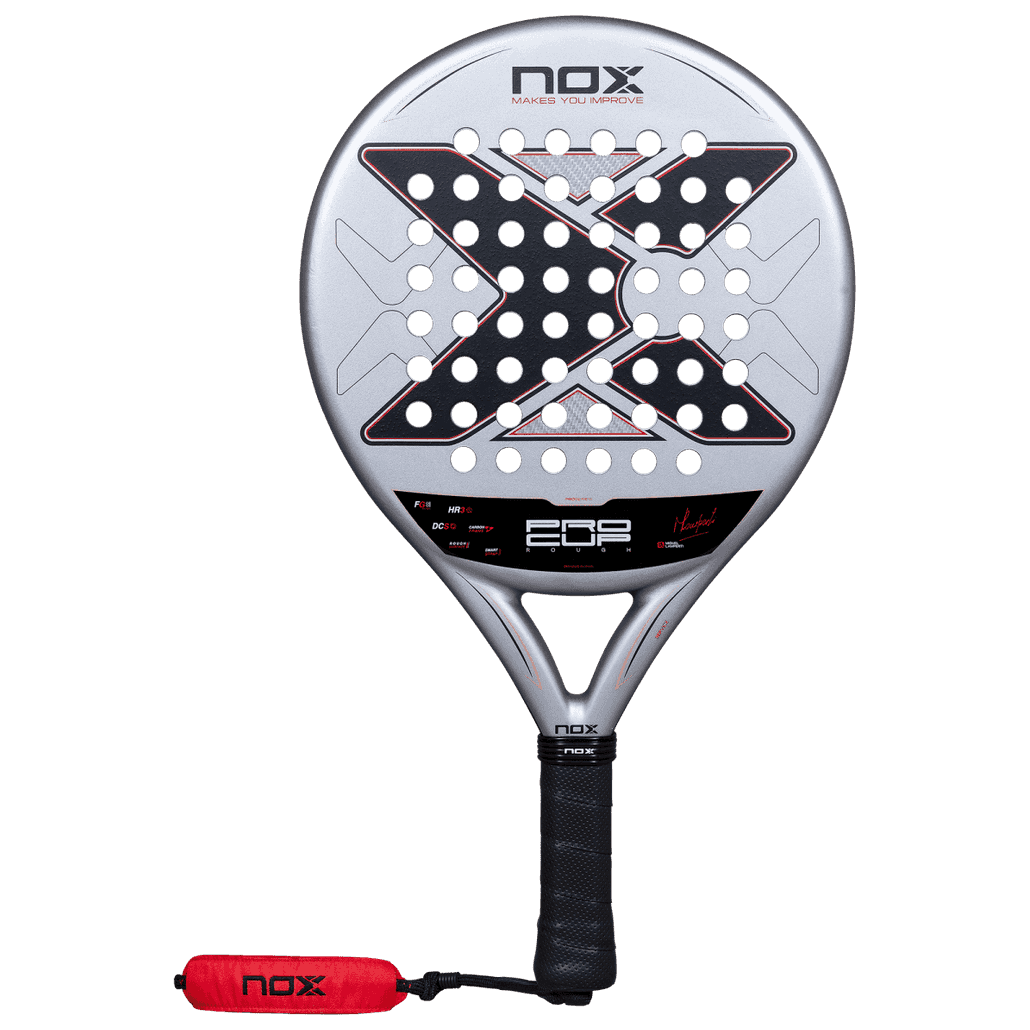
Nox ML10 Pro Cup Rough 2027 Miguel Lamperti is a comfort-first control racket with enough ball exit to keep the baseline from feeling passive. Its character is familiar: a forgiving, rounded platform that lets you play percentage padel without asking for a huge swing.
The Round shape, Soft feel, and broad sweet spot make it a racket I would trust on the days when my timing is not quite there. It is not built around brute-force finishing, though.
Technical analysis
Shape & balance
The round mold places the sweet spot centrally and gives this racket a very predictable response across the face. That matters most in defensive blocks, off-the-wall pickups, and volleys struck slightly outside the middle. I would not call it head-light, but its balance feels moderate enough that the head does not drag through quick exchanges.
Maneuverability is good rather than exceptional. Players coming from a very light, low-balance racket may notice a little more presence through the swing, especially on fast backhand volleys. In return, the racket feels stable when I need to absorb pace rather than flick at the ball.
Materials & construction
Nox uses a Carbon frame, Silver Fiberglass faces, and an HR3 EVA core. That combination explains much of the racket’s personality. Fiberglass softens the impact and gives the ball some easy release, while the EVA core keeps the response more controlled than springy.
The faces are not as crisp or direct as 12K or 18K carbon faces. I get a softer contact, more dwell time, and less punishment for imperfect technique. The trade-off is clear on aggressive attacking shots: the racket does not provide the immediate, hard rebound that stronger hitters may want.
On-court feel
Baseline play
From the baseline, this is where the ML10 Pro Cup Rough feels most natural. Defensive lobs come off with good height and depth without requiring a violent swing, and the racket helps me reset points after being pushed deep. The large sweet spot is useful on low balls after the wall, where clean contact is not always available.
Ball exit is generous, so I do need to soften my hands on short defensive blocks. If I simply present the face against a fast ball, it can travel more than intended. Still, that liveliness is useful for players who do not generate effortless depth from their own stroke.
At the net
At the net, it favors placement over intimidation. I can play controlled volleys, angle the ball, and use a chiquita without feeling that the racket will launch the ball unexpectedly. The soft contact also makes touch drop shots easier to judge.
What it does not do especially well is produce a heavy, penetrating volley with minimal effort. I need to accelerate properly to make the ball stay low and travel through the court. Players who like to win the net with sheer weight of shot may find it too gentle.
Bandeja and víbora
The racket suits a repeatable bandeja well. Its round format encourages a compact, controlled action, and the softer faces help me prioritize depth and direction over maximum speed. The rough finish should offer some extra bite, although it will not turn an average spin technique into a sharp víbora.
For the víbora, I find it more dependable than explosive. It gives me margin to keep the ball low, but it lacks the firmer, more immediate response of an attacking hybrid or diamond racket.
Conclusion
This is a strong fit for intermediate players and control-minded advanced players who value forgiveness, easy depth, and a soft response. It works particularly well for players who build points patiently, defend often, and prefer accurate net play over constant power.
The compromise is attacking ceiling. A smash can be effective with clean technique, but the racket does not add much free power, and it will not feel like a weapon for flat put-aways.
I see it as a reliable match racket rather than a statement racket: easy to trust, hard to mishit badly, and most convincing when the point calls for control.
Switch Intelligence
Be the first to share where you switched from.
Community reviews
Real feedback from players who used this racket.
Add your review
To submit your review, log in first. You can still read all approved community reviews below.
Add review


