

Royal Padel 35 Aniversario Poly 2025
A soft, forgiving tear-shaped racket that makes defense and net exchanges feel simple, while asking you to create your own finishing pace.
Shape
Tear
Weight
360 - 380 gr
Touch
Soft
Core
Soft polyethylene
Faces
Fibertech
Frame
Carbon
What we like
- Easy depth from compact swings
- Forgiving blocks and defensive lobs
- Quick, controlled *bandeja* placement
What we don't
- Flat smashes lack easy pace
- Muted feedback on short slices
- Reported cracking after impacts
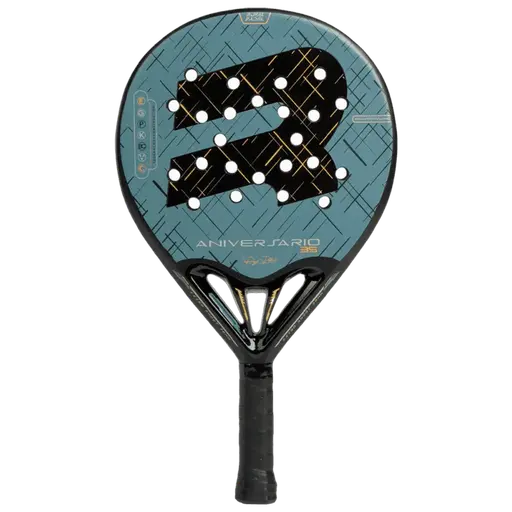
The Royal Padel 35 Aniversario Poly 2025 is a comfort-first racket built around easy depth, a broad margin for error, and calm defensive control. Its tear shape and soft feel make it far more interested in helping me construct points than ending them with one violent swing.
I see it as a racket for the player who values placement, quick hands, and a forgiving response—especially if a stiff, harsh impact has been bothering their elbow or shoulder.
It is not a power racket wearing a soft disguise. From the baseline to the net, it rewards compact technique and good decisions rather than brute force.
Technical analysis
Shape & balance
The tear profile and low balance give this racket a useful middle ground: enough surface to direct the ball with authority, but without the sluggishness I expect from a clearly head-heavy model. In the feedback I reviewed, its maneuverability repeatedly came up in defensive exchanges and rushed net situations, and that fits the design.
The sweet spot is notably generous. Off-center blocks and defensive lobs should not punish me as severely as they would with a firmer carbon-faced racket. That matters when I am arriving late to a ball after an awkward wall rebound.
Materials & construction
Royal Padel uses a carbon frame, Fibertech faces, and a soft polyethylene core. That combination explains the cushioned contact: the ball stays on the face slightly longer, the response feels muted rather than crisp, and the racket supplies easy ball exit without demanding a full swing.
Comfort is a genuine strength here. Players with elbow sensitivity have specifically praised that softer impact. The trade-off is feedback: on very short sliced shots, especially a delicate drop shot or chiquita, I would expect less precise information through the grip than from a firmer racket.
One note of caution: there has been at least one user report of cracking after impact. That is not enough to call it a widespread construction problem, but I would not dismiss it either.
On-court feel
Baseline play
From the baseline, this is where the 35 Aniversario Poly makes the most sense to me. Compact swings still send the ball deep, which is useful when I am defending under pressure and do not have time to load up. Blocks feel forgiving, and the soft core helps return pace without making the racket feel unstable.
Off-the-wall play should be comfortable as well. I would use it to reset points with height and depth rather than trying to force low, fast winners from difficult positions. The racket gives me help, but it will not add a sharp, penetrating finish to a passive ball.
At the net
At the net, its quick handling is valuable. I can get the face in place for reaction volleys and blocks, and the larger sweet spot gives some insurance when contact is not clean. It should suit players who win net exchanges through direction, depth, and repeated pressure rather than by hitting every volley flat and hard.
The softer face does mean I need to create pace myself. A firm punch volley will travel well, but the racket does not produce the heavy, immediate rebound of a harder setup.
Bandeja and víbora
The controlled response makes the bandeja a natural shot here. Even with late preparation, the racket should be easy to position and direct toward the fence or opponent’s feet. I would lean on it for percentage overheads and transition balls.
A víbora is workable, though players who want a very direct, sharp release may find the touch a little too dampened. The racket favors safety and placement over a cutting, aggressive finish.
Smash
The smash is the clear limitation. On a favorable, high ball, I can still finish points, but flat smashes need proper acceleration and clean timing. This is not the racket I would choose for regular par-3 attempts or for relying on raw power to bail me out.
Conclusion
I would recommend the 35 Aniversario Poly 2025 to intermediate and advanced players who want comfort, defensive depth, and a racket that behaves predictably in fast exchanges. It makes particular sense for someone moving away from a stiff, demanding setup.
What I trade off is finishing power and crisp feedback. If my game revolves around the smash and aggressive overheads, I would look elsewhere. If I build points patiently, defend with control, and want a soft racket that keeps difficult balls in play, this one has a very clear purpose.
What other reviewers say
- Racketguidees
User feedback describes a soft, comfortable, highly maneuverable racket with strong control for defensive play. Several players with elbow issues appreciate its comfort, but they consistently note reduced power; one review also reports cracking after receiving impacts.
- PadelTestLabde
The test highlights easy, deep ball output from the back court and forgiving volleys and blocks, helped by quick handling and a large sweet spot. It is easy to place on bandejas even with late preparation, but flat smashes lack whip and require the player to supply the pace.
- AvisPadelfr
This analysis finds it highly forgiving on off-center contact, comfortable in defense, and agile in quick net exchanges; it also helps send the ball deep from compact swings. It prioritizes control on bandejas and transition shots, while its smash works on favorable balls without being a regular par-3 weapon.
Switch Intelligence
Be the first to share where you switched from.
Community reviews
Real feedback from players who used this racket.
Add your review
To submit your review, log in first. You can still read all approved community reviews below.
Add review


