

Softee Chacal 2026
A soft, quick-handling tear shape that makes defense and fast volleys feel simpler, with more help on depth than outright finishing force.
Shape
Tear
Weight
355 - 365 gr
Touch
Soft
Core
EVA Soft
Faces
Fiberglass
Frame
Fiberglass
What we like
- Easy depth from baseline
- Forgiving on off-center blocks
- Quick handling in volleys
What we don't
- Limited smash finishing power
- Low-driven lobs lack penetration
- Soft face dampens hard drives
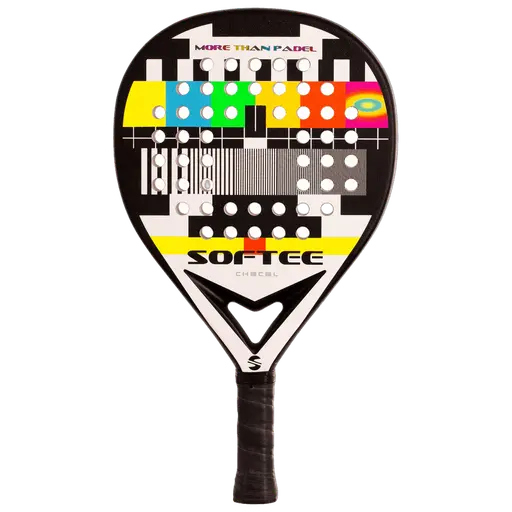
The Softee Chacal 2026 is a forgiving, easy-going racket built around clean ball exit rather than brute force. Its tear shape keeps enough attacking intent for regular club play, but the overall character is soft, quick, and much more comfortable than aggressive.
I see it fitting newer players and improving intermediates who want help from the racket at the baseline without carrying something sluggish at the net. The trade-off is clear: it will not turn a decent smash into a finishing shot.
Technical analysis
Shape & balance
The tear profile gives the Chacal a usable middle ground between a round control racket and a more demanding diamond. The sweet spot feels broad and accessible, particularly on contact that is slightly outside the center. That forgiveness matters in rushed volleys, blocks, and defensive returns where the swing is not always clean.
Although Softee does not present it as a head-heavy racket, I would not call it a pure head-light model either. It moves quickly through the air and feels easy to position, which matches its agile behavior in fast exchanges. Players who rely on heavy overhead acceleration may find that it lacks the extra mass and punch they expect from an attack-focused frame.
Materials & construction
A fiberglass frame and faces, paired with an EVA Soft core, explain much of the racket’s soft feel. The contact is cushioned rather than crisp, and the face gives the ball a helpful push even with a compact swing. From the back, that makes it easier to find depth without forcing the stroke.
The downside is a less direct response when I really want to drive through the ball. Fiberglass does not give the same firm, immediate feedback as stiffer carbon faces, so harder hitters may feel some energy disappear into the racket rather than transfer cleanly into the shot.
On-court feel
Baseline play
This is where the Chacal makes the most sense. Its ball exit is generous, and it helps on defensive lobs, off-the-wall balls, and neutral shots played under pressure. I do not need a huge backswing to send the ball deep, which is useful for players still learning to defend without overhitting.
It is also forgiving on blocks. A slightly late contact does not punish you as severely as it would with a hard, head-heavy racket. Still, the soft response can make it harder to play a very low-driven lob with real penetration; the racket favors a safer, higher trajectory over a sharp, attacking one.
At the net
Quick handling is one of its strongest traits. In volley exchanges, I can keep the racket in front, react late, and still get a useful response. The sweet spot helps when the ball arrives fast or close to the body, while the softer face makes touch volleys and drop shots easier to control.
What it does not do especially well is impose pace. A firm volley can be placed accurately, but it will not carry the same weight through the court as a stiffer carbon racket. Players who want to dominate the net with punchy, aggressive volleys may outgrow it.
Bandeja and víbora
The Chacal is comfortable for a controlled bandeja, especially when the goal is to keep the net and place the ball deep. Its maneuverability lets me work the angle without fighting the racket.
On the víbora, the softer face gives decent bite but not a particularly vicious release. I can shape the ball, yet I do not get the sharp, heavy skid that more attack-oriented rackets produce.
Conclusion
The Chacal suits players who value comfort, forgiveness, and easy depth over raw finishing power. It is a sensible racket for building confidence at the baseline and surviving quick net exchanges without needing a long, aggressive swing.
More advanced players with a naturally fast arm may find its ceiling limited. The smash is serviceable on a favorable ball, but it is not a weapon for consistently forcing x3 smashes or imposing pace from overhead.
What other reviewers say
- Pala Hacken
Its analysis positions it as a soft, beginner-oriented racket: maneuverability stands out at 8.25/10, with decent ball output and sweet spot, while power scores a modest 5/10.
- AvisPadelfr
The comparative review highlights very easy ball output, forgiveness on off-centre contact, and quick handling in fast net exchanges. It helps produce depth from the back with a compact swing, but its smash is more effective on favorable balls than as a decisive power weapon.
Switch Intelligence
Be the first to share where you switched from.
Community reviews
Real feedback from players who used this racket.
Add your review
To submit your review, log in first. You can still read all approved community reviews below.
Add review


