

Wilson Defy Pro V1 SE 2026
A hard-hitting diamond built for players who finish early, with a compact sweet spot and little patience for loose contact.
Shape
Diamond
Weight
370 gr
Touch
Medium
Core
Power Foam
Faces
15K Carbon
Frame
C2 Tubular Construction
What we like
- Heavy, penetrating overhead pace
- Direct punch on attacking volleys
- Strong baseline ball exit
What we don't
- Compact sweet spot punishes misses
- Slow setup on defensive blocks
- Off-center contact reduces comfort
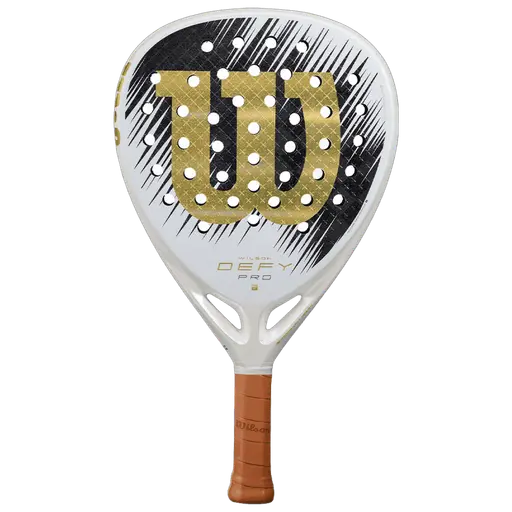
Wilson Defy Pro V1 SE 2026 is a serious attacking racket with very little interest in making the game easy for you. Its diamond shape, high balance, and firm, direct response are built around finishing points rather than absorbing pressure.
I felt its character most clearly above shoulder height. Give it a committed swing and clean contact, and it produces the heavy, fast ball that aggressive players look for.
That comes with a cost. This is not a forgiving racket in defense, nor is it especially quick through crowded exchanges at the net.
Technical analysis
Shape & balance
The diamond mold places the useful hitting area higher in the racket, while the head-heavy balance adds real momentum through the ball. That combination explains why the Defy Pro V1 SE feels so effective on attacking volleys, overheads, and full smashes.
It also explains its limitations. The sweet spot is compact, and contact away from its center loses more stability and direction than I would want in a more all-around racket. If your preparation is late or your defensive contact is regularly improvised, this Wilson can feel demanding rather than helpful.
Materials & construction
Wilson uses a C2 Tubular Construction frame, 15K carbon faces, and a Power Foam core. The result is a medium feel that sits on the firmer, more reactive side of medium rather than giving you a cushioned response.
The faces return energy quickly when I hit through the ball properly. There is strong ball exit from the baseline, but it does not feel trampoline-like or vague. The response is direct, with a solid impact that suits players who like to accelerate rather than guide the ball. Comfort is clearly secondary here: repeated off-center hits and long defensive points will be felt in the hand and arm more than with a softer, lower-balanced racket.
On-court feel
Baseline play
From the baseline, the Defy Pro V1 SE can drive the ball deep with less effort than its control rating might suggest. Clean groundstrokes and off-the-wall returns come off with plenty of penetration, especially when I can set my feet and take a full swing.
Under pressure, though, it asks for good timing. The high balance makes quick defensive blocks slower to set up, and the smaller sweet spot does not rescue a lazy contact. Defensive lobs need clean preparation; a rushed lob can come off flatter or shorter than intended. I would not choose this racket for a player whose game relies on soft hands and easy recovery from awkward positions.
At the net
At the net, its solidity becomes an advantage. Punch volleys carry weight without needing a huge swing, and the racket holds its line well when I attack through the middle. The direct face response also works nicely for an aggressive chiquita when there is enough time to shape it.
Fast exchanges are less comfortable. It is not particularly maneuverable, so rapid body volleys and last-second reaction blocks require stronger wrist control and earlier racket preparation.
Bandeja and víbora
This is one of its natural zones. A committed bandeja travels deep and heavy, while the víbora has the pace to force a weak reply when I find the center of the face. The head weight helps carry the racket through contact, producing the kind of penetrating overhead that keeps opponents pinned behind the service line.
Smash
The smash is the headline. Research around this racket consistently points to exceptional finishing pace, and that matches its construction and balance profile. Flat smashes feel forceful, while kick smashes benefit from the racket’s ability to transfer speed into the ball. It rewards technique, not shortcuts.
Conclusion
The Defy Pro V1 SE suits advanced attacking players who already strike the ball cleanly and want more authority in overheads, volleys, and point-ending smashes.
You trade forgiveness, quick handling, and some comfort for that power. Players who spend most of their time defending, rely on soft touch, or want help on off-center contact should look toward a more manageable, lower-balanced racket.
What other reviewers say
- PadelTestLabde
The test calls it a pure power racket: solid and demanding, rewarding sound technique with outstanding finishing pace on smashes and víboras plus strong ball output from the back. Its high balance makes it slower in defense, while the compact sweet spot punishes off-center contact.
- Padel Racket Reviewsen
The review rates its power among the strongest in its test database, with full weight and a head-heavy balance producing genuine finishing pace. In return, maneuverability, comfort, and forgiveness take a back seat, making it better suited to advanced players who already generate their own pace.
Switch Intelligence
Be the first to share where you switched from.
Community reviews
Real feedback from players who used this racket.
Add your review
To submit your review, log in first. You can still read all approved community reviews below.
Add review


