

Bullpadel Xplo 02 Comfort 2027
A lively diamond that brings easy depth and a generous sweet spot, keeping an attacking mindset composed when the point turns defensive.
Our Take
Recommended retail price €250 From €237 at 2 stores
Updated on 18 Nov


Updated on 18 Nov (shipping cost not calculated)





Are you a store owner? Join our platform to be featured here.
Shape
Diamond
Weight
360 - 370 gr
Touch
Medium-Soft
Core
MultiEVA
Faces
Fibrix
What we like
- Generous sweet spot on volleys
- Easy defensive lob depth
- Accessible smash and *bandeja* pace
What we don't
- Active rebound on touch shots
- Slower reactions in body volleys
- Muted feedback versus hard carbon
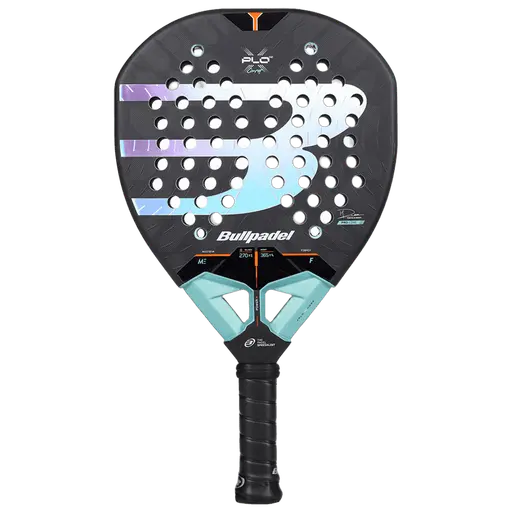
Bullpadel Xplo 02 Comfort 2027 is an attacking racket with a much friendlier response than its diamond shape suggests. It wants to play forward, but it does not punish you every time you defend under pressure.
I see it as a racket for the intermediate-to-advanced player who likes to finish points at the net yet still wants help on blocked balls, defensive lobs, and off-the-wall replies. Its medium-soft feel gives it a more forgiving character than a typical hard diamond.
Technical analysis
Shape & balance
The diamond mold puts the Xplo 02 Comfort in an offensive lane, with the sweet spot sitting high enough to reward clean contact above the net. Still, the notably generous sweet spot changes the experience: it is less temperamental on slightly late volleys and overheads than many power-oriented rackets.
That said, the head does not move as quickly as a round, head-light control racket. In fast exchanges close to the body, especially when reacting to a hard body volley, I would expect a little more preparation from the player. It is manageable, but not effortless.
Materials & construction
Bullpadel uses Fibrix faces and a MultiEVA core, a combination that explains the racket’s livelier ball exit. The face does not feel harsh, and the core gives the ball some useful rebound without requiring a huge swing.
That rebound is a real asset from the baseline, but it also means touch shots need restraint. On a soft chiquita or a short drop shot, the racket will not automatically absorb pace for you. I would not choose it for a player whose whole game depends on deadened, ultra-precise touch.
On-court feel
Baseline play
From the back of the court, the Xplo 02 Comfort is more cooperative than its silhouette implies. Blocks come off the face with enough depth, and the lively response helps when you are stretched and cannot generate much acceleration. Defensive lobs are accessible as long as you find the center of the face.
Its limitation is directional control at low speed. When I want to play a very measured low-driven lob or guide a slow ball tightly toward the side wall, the rebound can make the response feel a little too active. It rewards a clear, committed stroke more than a tentative one.
At the net
This is where the racket makes most sense. Firm volleys carry well through the court, while the forgiving contact zone gives some margin on rushed blocks and countervolleys. It has enough maneuverability to stay involved in quick net exchanges, even if it is not a feather-light racket.
The softer response also takes some sting out of defensive volleys, but players who prefer a crisp, hard-carbon impact may find it muted. The ball leaves cleanly rather than with that dry, sharply defined feedback some advanced players want.
Smash
On the smash, it has the accessible power you would expect from a diamond racket, but it does not demand flawless timing to produce depth. A controlled bandeja and víbora should benefit from the combination of a high contact zone and easy ball exit, particularly when you are trying to keep pressure rather than hit every overhead flat out.
Pure power hitters may still want a firmer, more head-heavy racket. This one helps generate pace, but it is not built around the most violent, rigid response.
Conclusion
The Xplo 02 Comfort suits an attacking player who wants diamond-racket intent without the usual hard, unforgiving feel. It should work particularly well for players moving toward a more aggressive net game but who still spend plenty of time defending from the baseline.
The trade-off is precision at very low pace and a less direct impact than a hard carbon model. If you value easy rebound, a broad sweet spot, and usable overhead power, that trade-off is reasonable.
Switch Intelligence
Be the first to share where you switched from.
Community reviews
Real feedback from players who used this racket.
Add your review
To submit your review, log in first. You can still read all approved community reviews below.
Add review


