

Star Vie Astrum 2027 Plus
A responsive tear-shape racket with a generous sweet spot, built to drive the point forward while keeping defensive work composed.
Shape
Tear
Weight
350 - 370 gr
Touch
Medium-Hard
Core
M-Eva Balance
Faces
12K Carbon Hyper
Frame
Carbon
What we like
- Generous sweet spot on blocks
- Lively depth from defensive lobs
- Stable, punchy volley response
What we don't
- Active ball exit hurts touch
- Average speed in fast hand battles
- Not a pure finisher's racket
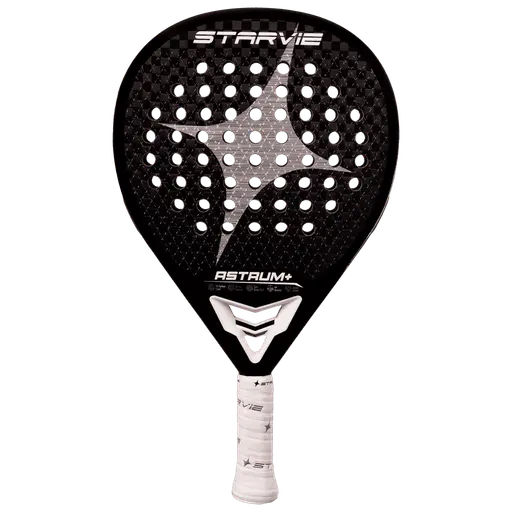
The Star Vie Astrum 2027 Plus is a responsive attacking-control racket built around a large contact area rather than raw head-heavy violence. It has enough firmness to hit through the ball, but its real calling card is how easily it returns depth from less-than-clean contact.
I see it fitting intermediate-to-advanced players who construct points from the baseline and want a dependable racket once they move forward. It is not a soft, effortless option, and it will not hide a late swing.
Its tear shape keeps the balance in a useful medium zone: quick enough for exchanges, with enough mass above the hand to make overheads count.
Technical analysis
Shape & balance
The tear format gives the Astrum a more neutral personality than a full diamond racket. The sweet spot sits high enough to reward aggressive volleys and overheads, yet it remains broad enough that defensive blocks do not feel like a constant precision test.
That generous sweet spot is one of the racket’s strongest practical traits. I found it easier to keep the ball deep when receiving fast shots near the body or playing hurried off-the-wall returns. Maneuverability is solid rather than exceptional: the medium balance gets it into the ball quickly, but it is not the lightest option for rapid hand battles at the net.
Materials & construction
The carbon frame, 12K Carbon Hyper faces, and M-Eva Balance core produce a firm, connected strike. This is a medium-hard feel, but not a harsh one. There is a noticeable dwell time on controlled shots before the face returns energy, which helps explain its lively ball exit.
That rebound is useful from the back of the court, especially when the opponent plays with pace. Still, the racket can give away more depth than intended if I simply put the face behind the ball. Players who rely on dead blocks and slow, absorbing touch may prefer a softer core.
On-court feel
Baseline play
From the baseline, the Astrum feels forgiving for a carbon-faced racket. Defensive lobs come off with good height and length, and I can play a low-driven lob without having to force the arm through the ball. On off-the-wall shots, the broad sweet spot reduces the punishment for slightly late contact.
Control is good rather than surgical. The racket gives plenty of output, so short angles, drop shots, and delicate chiquitas require a relaxed hand. If I overwork the stroke, the ball leaves faster than I want.
At the net
Volleys are solid and direct. The face stays stable against hard drives, and the racket has enough rebound to turn a simple block into an attacking ball without a huge swing. Its balance also adds weight to firm volleys down the middle.
In fast exchanges it gets into position quickly for a carbon racket. Players who want an ultra-light racket for reaction volleys and last-second changes of direction may still prefer something lighter.
Bandeja and víbora
This is where the Astrum makes a strong case for itself. The medium-hard response lets me accelerate a bandeja without the face feeling vague, while the carbon surface provides a clean, predictable release on a víbora. Direction is easy to trust when I strike in the center.
The rough Spin Boost Tech surface adds bite when I brush the ball, which helps it dip or skid after the glass. It still rewards proper wrist mechanics; a flat, lazy contact does not produce much spin.
Conclusion
The Astrum 2027 Plus suits players who want a firm, lively racket with a notably generous sweet spot. It works particularly well for players who defend with depth, build the point patiently, and want more authority in volleys and overheads without moving into an uncompromising diamond shape.
The trade-off is clear: its ball exit can be too active for passive touch, and the balance is not the quickest for pure hand-speed players. I would choose it for an assertive all-court game, not for someone looking for a soft, muted racket that does most of the defensive work for them.
Switch Intelligence
Be the first to share where you switched from.
Community reviews
Real feedback from players who used this racket.
Add your review
To submit your review, log in first. You can still read all approved community reviews below.
Add review


