

Star Vie Drax 2027 Plus
A composed tear-shape that rewards measured construction, with a firm response, a generous sweet spot, and enough finish at the net.
No store price yet
See similar racketsShape
Tear
Weight
350 - 370 gr
Touch
Medium-Hard
Core
M-Eva Balance
Faces
12K Carbon Hyper
What we like
- Stable volleys under heavy pace
- Broad sweet spot on mishits
- Controlled *bandeja* and *víbora* placement
What we don't
- Limited passive defensive ball exit
- Demanding spin and cut shots
- Less lingering hold on touch shots
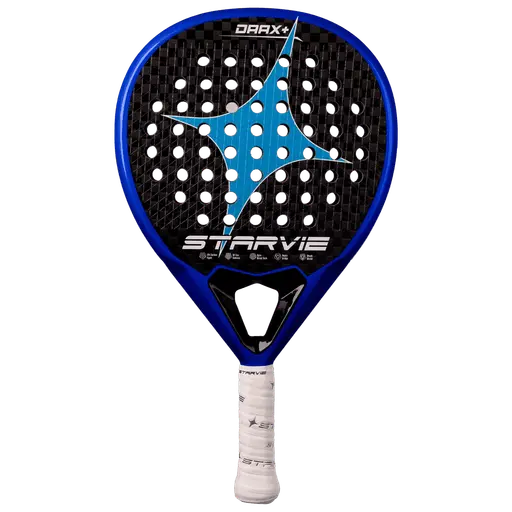
The Star Vie Drax 2027 Plus is a composed attacking racket rather than a blunt power tool. It has enough punch to finish a short ball, but its real strength is keeping the point organized while you build pressure.
I found its tear shape and medium-hard feel most convincing for an intermediate-to-advanced player who values a stable response over free, springy ball exit. It does not do the work for you from the baseline, but it rewards clean preparation and a deliberate swing.
Technical analysis
Shape & balance
The tear profile gives the Drax a useful middle ground between a round control racket and a demanding diamond. Its balance feels centered enough to maneuver quickly in exchanges, yet there is sufficient mass through the upper section to make volleys and overheads land with intent.
That balance also explains its forgiving character. The sweet spot feels broader than I expected from a racket with this much attacking potential, and mishits remain reasonably stable rather than twisting the frame in the hand. Still, it is not head-light. Quick defensive reactions are fine, but players who want an extremely fast, effortless racket at the net may find it a touch more substantial than they prefer.
Materials & construction
The 12K Carbon Hyper faces give contact a direct, controlled firmness without becoming harsh. Paired with the M-Eva Balance core, the response is compact and damped; I noticed less unwanted vibration on blocks and off-center contact than on many firmer carbon rackets.
Ball exit is high when I actively compress the ball, especially on drives and volleys. Passive shots are another matter. The Drax does not fling the ball back for you, so a late defensive lob or a lazy block can die shorter than intended. That controlled rebound is useful for placing the ball, but it asks more of your technique under pressure.
On-court feel
Baseline play
From the baseline, the Drax feels steady and predictable. Off-the-wall play benefits from the stable face, and I could direct defensive lobs with confidence once I had time to set the racket. Low-driven lobs also come off cleanly because the face does not overreact at contact.
The trade-off is clear: this is not a soft, easy-exit racket for digging out balls with a short swing. Against heavy pace, I needed to push through the shot. Players who rely on the racket to add depth when defending late will get less help here than from a softer core.
At the net
At the net, the Drax makes more sense. Volleys feel firm, accurate, and notably stable through contact. I could block hard balls without the face fluttering, then accelerate the next volley without losing direction. The larger sweet spot is valuable in fast hand battles.
Touch shots are competent rather than exceptional. A chiquita or drop shot can be placed well, but the firmer response does not provide the lingering ball hold that some touch-focused rackets offer. Spin is also not its strongest area; I could shape the ball, but demanding cut and heavy sidespin require proper racket-head speed.
Bandeja and víbora
The Drax is very reliable overhead. My bandeja stayed deep with a controlled trajectory, while the víbora had enough firmness to travel through the court without feeling wild. It favors placement and repeatability over exaggerated bite.
A smash is solid, particularly when the ball is in front and the swing is committed. It will not hand out effortless winners, though. This is a racket for constructing the overhead attack, not just chasing power.
Conclusion
I would pick the Drax 2027 Plus for a player who already generates their own pace and wants a stable, balanced racket for organized attacking play. It works especially well for players who spend time controlling the net with volleys, bandejas, and measured víboras.
What you trade away is easy defensive depth and aggressive spin assistance. The Drax asks for a proper swing from the back and does not soften poor contact as much as a more elastic racket. In return, it gives a firm, calm response that stays trustworthy when the point speeds up.
What other reviewers say
- Pádel Análisises
It characterizes the racket as a balanced control-oriented model with a medium-firm feel and some attacking versatility. It highlights stability, a broad sweet spot, and vibration damping, while noting restrained passive ball output and less help for demanding spin shots.
Switch Intelligence
Be the first to share where you switched from.
Community reviews
Real feedback from players who used this racket.
1 review

Add your review
To submit your review, log in first. You can still read all approved community reviews below.
Add review


