

Tecnifibre Curva Soft 2027
A soft-feeling tear shape that sends the ball easily, with enough composure to work the baseline before finishing at the net.
Shape
Tear
Weight
360 gr
Touch
Soft
Core
Soft Foam
Faces
18K Carbon
Frame
Carbon and fiberglass
What we like
- Easy depth from baseline
- Quick handling in net exchanges
- Forgiving sweet spot on defense
What we don't
- Less punch on flat smashes
- Elastic feedback on touch shots
- Less precise than firmer cores
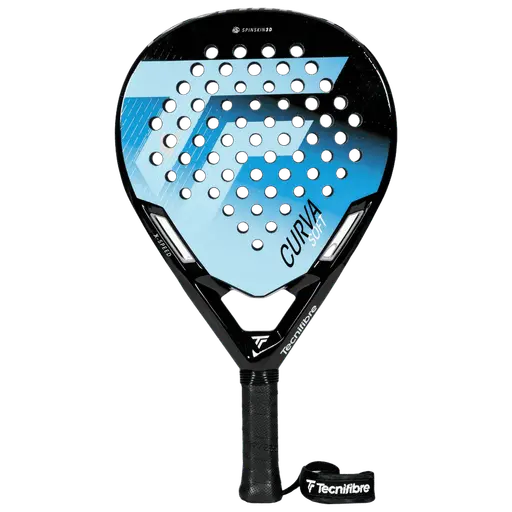
Tecnifibre Curva Soft 2027 is a tear shape racket built around easy acceleration and a forgiving response rather than a hard, demanding hit. Its character is offensive enough for players who want to press at the net, but the soft feel keeps it accessible from the baseline.
I see it as a racket for the regular intermediate player who wants help generating depth without moving into a head-heavy, stiff power frame.
It will not satisfy players who want a very dry, surgical impact or a racket that rewards full-speed overheads with maximum raw finish.
Technical analysis
Shape & balance
The tear profile gives the Curva Soft a useful middle ground between a round control racket and a diamond attack model. The sweet spot sits high enough to make volleys and overheads feel purposeful, yet it should remain easier to find than on a more aggressive diamond shape.
Its balance appears geared toward a quick, attacking game rather than sheer head weight. I would expect it to move cleanly through short backswing volleys, blocks, and fast exchanges at the net. That maneuverability matters when the point gets rushed and there is no time to set up a full stroke.
The trade-off is simple: it should not deliver the same heavy, late-hit momentum as a genuinely head-heavy racket. Players who rely on a flat smash to finish through brute force may want more mass in the head and a firmer layup.
Materials & construction
Tecnifibre combines a carbon and fiberglass frame with 18K carbon faces and a Soft Foam core. On paper, that is an interesting mix: the faces should provide enough stability and bite to keep the racket from feeling vague, while the softer core supplies the high ball exit suggested by its profile.
That softer foam should be particularly useful on defensive contacts. When I am late on an off-the-wall ball or simply need to guide a block deep, I prefer a racket that gives something back without requiring a hard swing. The Curva Soft looks built for that kind of assistance.
Still, Soft Foam generally means less crisp feedback at the exact moment of impact. Players who like to feel the ball sit briefly on the face for delicate chiquitas, low drop shots, or very precise changes of pace may find the response slightly more elastic than they want.
On-court feel
Baseline play
From the baseline, the high rebound is likely the main story. Defensive lobs and lifted returns should come off with less effort, and the generous sweet spot ought to reduce the punishment for contact slightly outside the center.
I would use that ball exit to play with margin rather than forcing low, flat winners from the back. It should help keep the ball deep, but it will not automatically make a passive defense accurate; soft response can send the ball long if the racket face is too open.
At the net
At the net, this should be a lively racket. Quick volleys, punch blocks, and redirected balls ought to come off easily, especially for players who do not generate huge racket-head speed. The 18K faces should add enough structure to stop the racket from fluttering against a hard volley.
For a controlled bandeja or víbora, I expect good height and depth rather than a brutally penetrating ball. That is useful for building pressure, but advanced players looking for a very sharp, hard contact may miss a firmer core.
Conclusion
The Curva Soft suits intermediate and improving advanced players who want fast handling, easy ball exit, and an attacking shape that does not punish them from defense. I would look at it for a game based on active volleys, consistent overheads, and depth from the baseline.
What you trade off is firmness. It should be more forgiving than explosive, and more comfortable than brutally precise. If your game depends on a punishing smash or a hard, compact response on every touch shot, this is probably not the Tecnifibre to choose.
Switch Intelligence
Be the first to share where you switched from.
Community reviews
Real feedback from players who used this racket.
Add your review
To submit your review, log in first. You can still read all approved community reviews below.
Add review


