

Dunlop Titan Pro 2024
A forgiving tear-shape with easy depth and a broad sweet spot, built for steady defense-to-net play rather than all-out force.
Our Take
Shape
Tear
Weight
370 gr
Touch
Medium
Core
Mega Flex Core
Faces
Double layer of highly flexible fiberglass
Frame
Wavy graphite frame with a 100% carbon insert in the bridge
What we like
- Forgiving sweet spot on blocks
- Easy depth on defensive lobs
- Stable volleys through transitions
What we don't
- Limited bite on *víboras*
- Less crisp flat-shot response
- Slows during rapid volley exchanges
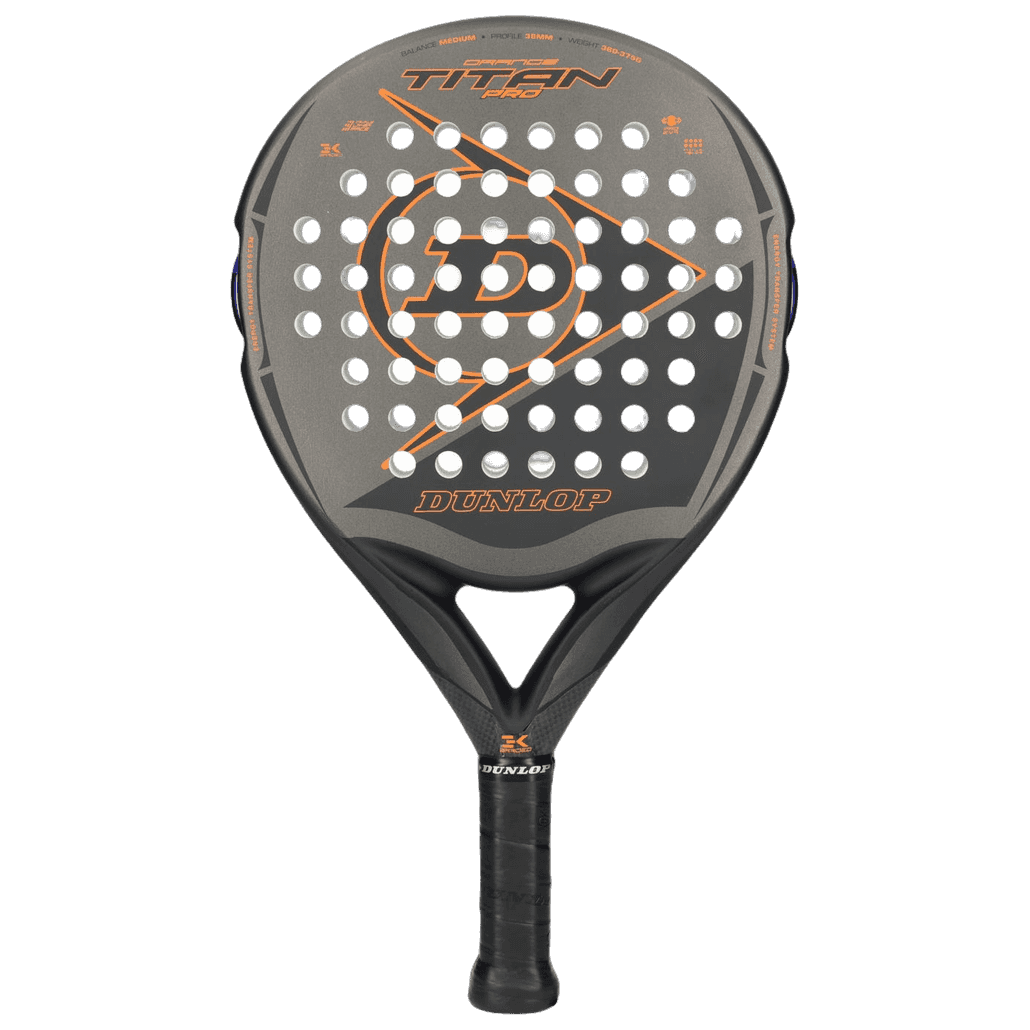
Dunlop Titan Pro 2024 is a forgiving tear-shaped racket with an attacking edge, but it earns its keep through easy depth rather than brute-force finishing. I found it more comfortable in long points than its orange cosmetics suggest.
The tear shape and medium feel suit players who want help from the baseline without arriving late to every exchange at the net. It is not a sharp, hard-hitting carbon weapon. That is also why it is easier to use.
Technical analysis
Shape & balance
The moderately high hitting area gives this racket a notably broad sweet spot. Off-center contact still carries enough ball exit to keep a defensive lob deep or send a blocked volley back with purpose. That forgiveness is one of its strongest traits, especially when the ball arrives fast or low.
Its balance sits around the middle rather than pulling aggressively toward the head. I could transition from defense to attack without fighting the racket, and the oversized head helps stabilize the face on blocks. Still, it is not especially quick in frantic hand battles; after repeated fast volleys, the racket can start to feel slower than a more maneuverable, head-light option.
Materials & construction
Dunlop uses a graphite frame with a carbon bridge insert, paired with double-layer fiberglass faces and the Mega Flex Core. On court, that construction produces a flexible response with plenty of accessible rebound. The ball leaves the faces easily, even when I am not loading the shot perfectly.
Fiberglass brings comfort and a wider margin for error, but it also limits the crispness. Flat attacking shots do not come off with the dry, immediate response I expect from stiff 12K or 18K carbon faces. The smooth surface is another compromise: it does not offer much extra bite, so spin-heavy shots depend more on technique than on the racket helping you.
On-court feel
Baseline play
From the baseline, this is where I enjoyed the Titan Pro most. Wall returns came out with reassuring depth, and I did not need a huge swing to lift the ball over opponents at the net. Defensive lobs are easy to send deep, while low-driven lobs carry enough pace to make opponents move backward.
That easy output can occasionally work against precision. If I tried to play very fine angles or slow the ball down sharply, the flexible face gave me less exact feedback than a firmer racket. It rewards clean preparation, but it will not disguise loose direction.
At the net
The generous sweet spot makes volleying straightforward. Blocks feel stable, and firm volleys can be placed deep without needing to overhit. I also liked it when closing the net after defending: it reacts predictably enough to play a controlled first volley rather than simply surviving the transition.
In rapid exchanges, though, the racket is not as nimble as its balanced setup first suggests. Players who live on reflex volleys and constant changes of grip may prefer a lighter-feeling frame. The Titan Pro is better at absorbing and redirecting than flicking the racket through every ball.
Bandeja and víbora
The flexible response helps the bandeja travel deep without excessive effort. Even slightly imperfect contact still produced a useful, penetrating ball, which matters when I am hitting under pressure after a high lob. A víbora can be directed well too, but the smooth faces do not create the heavy side-spin that textured carbon rackets can generate.
Power overhead is usable rather than explosive. A smash accelerates well with good timing, but flat winners do not have the violent release of a stiffer, head-heavy racket. I would use it to build pressure and finish the right ball, not expect it to manufacture power from poor position.
Conclusion
The Titan Pro 2024 suits intermediate and advanced players who value comfort, forgiveness, and dependable depth across the court. I would particularly consider it for players whose defense and transition game need more help than their smash.
The trade-off is clear: less spin assistance, less crisp feedback, and less raw finishing power than a hard-carbon attacking racket. It is a composed racket for constructing points, not a specialist weapon for ending them.
What other reviewers say
- PadelStares
The review finds it to be an all-round racket with an attacking lean, supplying punch without the head-heavy feel of a pure power model. Its oversized head helps on volleys, blocks, and defense, while the flexible feel adds easy ball output and comfort at the expense of some pinpoint precision and spin.
- PadelTestLabes
This analysis highlights notably easy ball output and depth on bandejas, lobs, and wall returns, even from imperfect contact. Conversely, the 370 g weight slows repeated quick volleys, the smooth face contributes little spin, and flat smashes lack the crisp response of a stiff carbon racket.
- Bestpadelen
In its test of the White version, Bestpadel rates control above power and reports consistent performance across different situations. The generous sweet spot and fiberglass feel make it relatively forgiving in long rallies, but the smooth surface scores poorly for spin.
- Padel Passionfr
This test finds usable power and good acceleration on smashes and firm bandejas without requiring perfect timing, but does not consider it a raw-power racket. It particularly praises easy depth control and maneuverability when transitioning between the baseline and net.
Switch Intelligence
Be the first to share where you switched from.
Community reviews
Real feedback from players who used this racket.
Add your review
To submit your review, log in first. You can still read all approved community reviews below.
Add review


