

Enebe Furius Max Holographic 2027
A forgiving tear-shape racket with lively ball exit, giving baseline defense and quick net exchanges equal billing.
Our Take
Shape
Tear
Weight
350 - 365 gr
Touch
Medium
Core
EVA Mid-soft
Faces
Carbon + Glass
Frame
Carbon
What we like
- Lively ball exit in defense
- Large sweet spot on blocks
- Quick handling in net exchanges
What we don't
- Limited authority on flat smashes
- Eager exit reduces touch precision
- Less bite on aggressive víboras
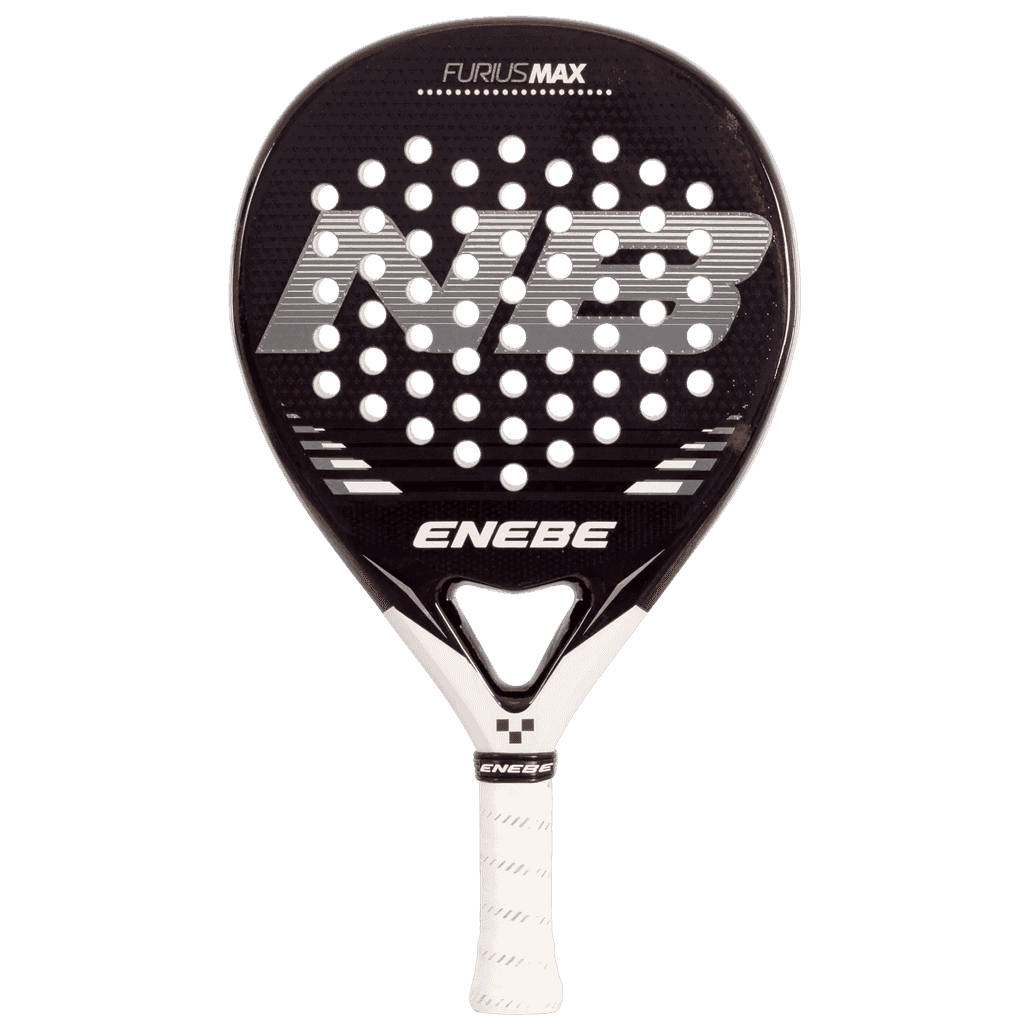
Enebe Furius Max Holographic 2027 is a quick, forgiving tear-shaped racket with more ball exit than its medium feel suggests. I read it as a racket for players who want help from the core in defense but still want enough structure to press at the net.
It does not have the demanding, head-heavy character of a pure attacking model. That is part of its appeal. The racket gets moving easily and gives you a broad margin when contact is not dead center.
Its trade-off is clear: it can accelerate the ball well, but it will not give a big hitter the brutally direct finish of a hard carbon racket.
Technical analysis
Shape & balance
The tear shape puts the Furius Max Holographic in a sensible middle ground. There is enough mass toward the upper half of the frame to make volleys and overheads feel purposeful, but the balance does not make the racket slow through preparation.
That maneuverability matters in fast exchanges. I would expect it to feel particularly natural for players who defend from the baseline, then need to transition quickly into a compact volley or block. The large sweet spot should also reduce the punishment for slightly late contact, especially on off-the-wall play.
Still, this is not a racket that generates attacking weight entirely by itself. On a flat smash, you need to accelerate through the ball rather than rely on a high balance to do the work.
Materials & construction
The carbon frame gives the structure some needed stability, while the carbon and fiberglass faces should soften the impact compared with a full, stiff carbon layup. That combination fits the racket’s medium feel: not plush, not dry, and generally more accessible than a hard-faced power racket.
Its EVA Mid-soft core is the main source of the lively response. There is plenty of ball exit on defensive blocks, lobs, and compact countervolleys. I like that kind of core when the ball is wet, slow, or sitting low after the glass.
The limitation is touch precision at very low pace. A softer, more reactive setup can make delicate drop shots and short chiquitas less exact unless I relax the hand and absorb the ball carefully.
On-court feel
Baseline play
From the baseline, this racket should be one of the easier Enebe options to use. The response helps get depth without forcing a full swing, and the sweet spot offers useful forgiveness when defending under pressure.
Low-driven lobs come off the face with little effort. So do blocked returns. That said, players who prefer to really hold the ball on the face before guiding it may find the exit a little too eager.
At the net
At the net, the Furius Max Holographic looks strongest in quick, practical padel. It should be easy to bring into position for reaction volleys and body blocks, while the frame keeps the racket from feeling flimsy on firmer contact.
I would use it to build pressure with placement rather than chase outright winners. It has enough bite for controlled volleys, but it is not a particularly hard or sharp racket for punching through opponents from below net height.
Bandeja and víbora
The medium response and manageable balance suit a controlled bandeja well. I would expect good depth without having to overhit, especially when playing the ball back toward the corner.
A more aggressive víbora is possible, but the racket’s softer exit means I would focus on slice and direction over raw pace. Players who want a very dry, immediate response on overhead spin shots may want a firmer face.
Conclusion
I would put this racket in the hands of an intermediate player, or an advancing player, who values easy handling, a generous sweet spot, and help in defense. It makes sense for a player who spends plenty of time constructing points rather than ending every overhead.
The trade-off is less authority on the smash and less surgical feel on soft touch shots. Its strength is not brute force. It is a responsive, fast racket that keeps the game moving when the point gets messy.
Switch Intelligence
Be the first to share where you switched from.
Community reviews
Real feedback from players who used this racket.
Add your review
To submit your review, log in first. You can still read all approved community reviews below.
Add review


