

Royal Padel Fury 2026
A planted diamond built to drive the smash, with a firm response that asks real work of the arm in quick exchanges.
Shape
Diamond
Weight
365 - 380 gr
Touch
Medium-Hard
Core
MID HARD EVA Foam
Faces
12K Carbon
Frame
Bidirectional double tubular frame, 100% 3K 3D Hexcel Twill Aeronautical Carbon
What we like
- Heavy, penetrating net volleys
- Dense, decisive smash contact
- Stable, crisp overhead response
What we don't
- Slow in quick hand battles
- Demanding late defensive blocks
- Reduced sweet spot forgiveness
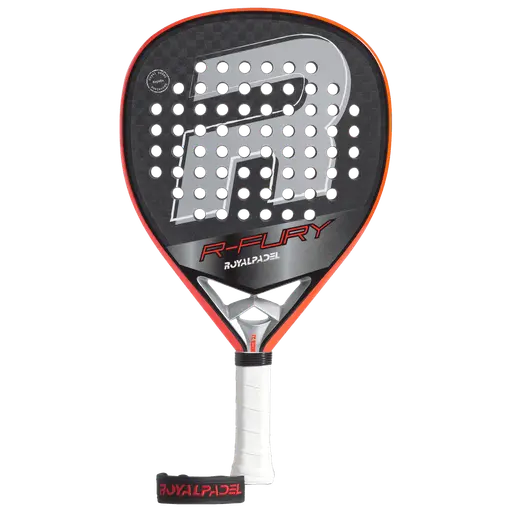
Royal Padel Fury 2026 is a demanding attacking racket: planted through contact, firm in the hand, and built to put real weight behind the ball. It does not flatter a lazy swing or rushed preparation.
Its diamond shape and medium-hard feel point clearly toward aggressive players who want to take charge from the net and finish overheads. The trade-off is speed. This is not a quick, flickable racket for frantic exchanges.
Technical analysis
Shape & balance
The Fury’s diamond profile puts the sweet spot higher in the face, and the racket plays with a distinctly head-heavy sensation. That setup gives it authority on volleys, overheads, and any shot where I can get the racket moving through the ball.
I would not call the sweet spot generous. It is usable, but contact needs to be clean, particularly on defensive shots taken late or below net height. Reviews consistently describe the Fury as a heavy, stable hitter, and that comes through in its likely balance behavior: very solid once set, slower when I need to react quickly.
Materials & construction
Royal Padel uses a double tubular frame built from 3K 3D Hexcel Twill Aeronautical carbon, with 12K carbon faces and an EVA MID HARD core. On court, that recipe should produce a direct, compact response rather than a springy one.
The face and frame construction are the reason the Fury feels so settled at impact. It resists twisting well on firm volleys and blocks, and the ball does not feel as though it disappears into the core. Ball exit is moderate rather than effortless, though. I need to supply pace with my own swing; the racket rewards acceleration but does not generate much free depth from a passive contact.
On-court feel
Baseline play
From the baseline, the Fury is more capable than forgiving. Its firm response lets me drive a defensive lob with purpose and play a low-driven lob without the face feeling vague. Off-the-wall play can be very accurate when I arrive early and strike through the ball.
Under pressure, though, the racket asks a lot. The reported slow handling in fast exchanges is the main limitation here. Late blocks and emergency pickups require more forearm strength than they would with a more head-light racket, and I would not choose it for a player whose defense relies on quick wrist adjustments.
At the net
At the net, the Fury makes more sense. The stable frame gives volleys a heavy, penetrating contact, especially when I am pressing the middle or taking the ball early. It holds its line well on punch volleys and firm blocks against a hard counterattack.
Quick hand battles are less comfortable. Changing from a backhand volley to a short forehand reaction takes more work, and delicate drop shots require a soft hand because the face is not especially forgiving.
Bandeja and víbora
The Fury’s planted feel helps me hit a penetrating bandeja without overhitting. A more aggressive víbora also benefits from the firm face, which gives a crisp response and enough stability to keep the ball moving through the court.
Smash
This is its natural territory. Once I can load the swing, the racket transfers energy very well and gives the smash a dense, decisive strike. It favors players who hit through the ball rather than those relying on easy rebound.
Conclusion
I would put the Fury in the hands of an advanced or strong intermediate player with sound overhead technique and enough arm strength to manage a demanding balance. It suits an attacking player who wants stable volleys, forceful overheads, and a firm response.
The price for that authority is maneuverability. Defensive reactions, quick exchanges, and off-center contacts are not its strong points. Players who want easy ball exit or a more agile racket should look elsewhere.
What other reviewers say
- PadelRacketReviews.comen
The review characterizes it as a heavy, planted racket that produces strong power and a firm, stable strike. The trade-off is slow handling in fast exchanges, with a real demand on arm strength.
Switch Intelligence
Be the first to share where you switched from.
Community reviews
Real feedback from players who used this racket.
Add your review
To submit your review, log in first. You can still read all approved community reviews below.
Add review


