

Joma Hyper Pro Hard 2026 Vero Virseda
A hard, head-heavy diamond built to make the smash count, with enough discipline in defense for players who can handle its demands.
Shape
Diamond
Weight
360 - 370 gr
Touch
Hard
Core
Flexo Black EVA HRD
Faces
12K Carbon
Frame
DualTech Frame (100% carbon fiber tubular)
What we like
- Punishing high-balance smashes
- Heavy, driving punch volleys
- Direct response on *víboras*
What we don't
- Small, high sweet spot
- Demanding defensive lob depth
- Slow in fast net exchanges
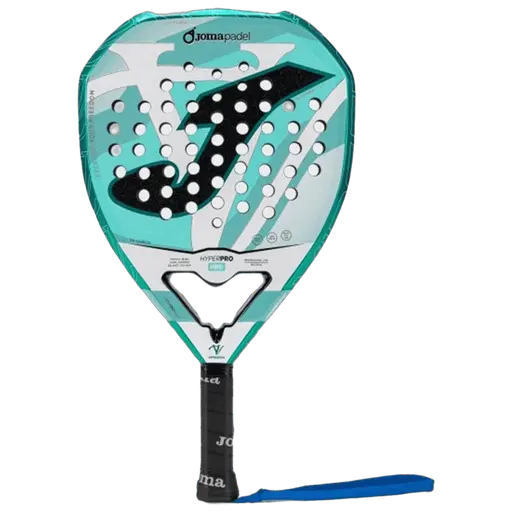
Joma Hyper Pro Hard 2026 Vero Virseda is built to hit through the ball, not cushion it. This is a serious attacking racket with a diamond shape, a demanding hard feel, and a response that rewards a fast, committed swing.
I see it fitting experienced players who want to take charge at the net and finish points overhead. It will not flatter a passive game from the baseline, and it is not the racket I would choose for easy defensive help.
Technical analysis
Shape & balance
The diamond mold places the sweet spot high, and the balance follows that same attacking logic. It feels naturally inclined toward overhead shots, aggressive volleys, and any ball struck in front of the body. When I accelerate properly, the racket carries a lot of momentum into the ball.
That comes with a clear cost. Maneuverability is not its strong suit, particularly in rushed exchanges or quick hand battles close to the net. The relatively compact sweet spot also means off-center contact loses more stability and pace than it would with a rounder, more forgiving racket.
Materials & construction
Joma uses a DualTech Frame with a 100% carbon fiber tubular structure, 12K carbon faces, and a Flexo Black EVA HRD core. On court, that construction translates into a firm, fairly dry impact with limited trampoline effect. The ball does not fly off the face for free; I need to supply the acceleration.
The upside is a direct, clean response. Hard hitters will appreciate the way the face stays composed when driving volleys or flattening a víbora. There is also enough rigidity to keep the racket from twisting badly on solid blocks. Still, players who rely on easy ball exit for defensive lobs may find the core too demanding.
On-court feel
Baseline play
From the baseline, the Hyper Pro Hard asks for preparation. Its lower rebound means defensive balls need a fuller swing, especially after the wall when I am trying to lift the ball deep without opening up the court. A casual touch does not produce much depth.
With good timing, though, it is accurate. I can drive a low-returning ball with confidence and send a low-driven lob without the racket feeling vague. Blocks work best when I meet the ball firmly rather than trying to absorb everything with a soft hand. This is control through firmness, not control through forgiveness.
At the net
The racket makes more sense once I take the net. Volleys come off heavy, and the hard face gives a precise enough response to attack the middle or press toward the fence. It feels particularly effective on punch volleys, where the high balance helps the racket continue through contact.
Quick reaction volleys are less comfortable. If the ball arrives at shoulder height and late, the head can feel slow to reposition. Players who build their net game around fast hands and subtle touch may prefer a less head-heavy setup.
Smash
This is its main territory. The high balance and hard construction help turn a well-struck smash into a genuinely punishing ball. Flat finishes feel forceful, while a technically sound kick smash gets a crisp, connected strike rather than a mushy launch.
It does not manufacture power from poor mechanics. Contact below the sweet spot feels noticeably less rewarding, so this is a racket for players who can consistently get behind the ball overhead.
Conclusion
I would put the Hyper Pro Hard in the hands of an advanced or high-intermediate attacker with reliable overhead technique. It suits players who want firmness, direct feedback, and real authority on volleys, bandejas, víboras, and smashes.
The trade-off is comfort. Its sweet spot is not generous, its ball exit is modest, and defensive play requires active footwork and a committed stroke. If you want the racket to do much of the work on slow balls, this one will feel hard work.
Switch Intelligence
Be the first to share where you switched from.
Community reviews
Real feedback from players who used this racket.
Add your review
To submit your review, log in first. You can still read all approved community reviews below.
Add review


