

Siux Fenix Pro SE 2.0 2026
A hard, high-balance diamond built to put away short balls, rewarding committed swings and clean technique at the net.
Shape
Diamond
Touch
Hard
Core
EVA
Faces
12K Honeycomb Carbon
What we like
- Explosive flat-smash finishing power
- Penetrating volleys with firm response
- Direct feedback on clean contact
What we don't
- Demanding defense under pressure
- Compact, high-positioned sweet spot
- Limited ball exit at baseline
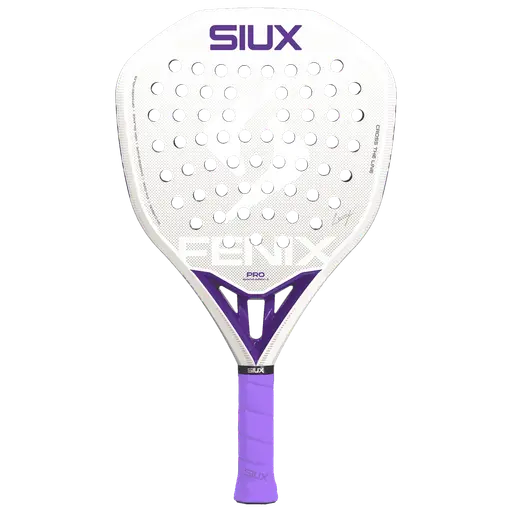
The Siux Fenix Pro SE 2.0 2026 is a racket built to finish points, not to make defensive padel feel easier. It has the unapologetic character of a diamond shape power racket: high balance, a compact sweet spot, and a response that rewards a fast, committed swing.
I felt its hard feel immediately. There is very little free help at low speed, but once I accelerated through the ball, the response became direct and heavy.
This is aimed at advanced attackers who want to impose themselves at the net and have the technique to manage a demanding balance.
Technical analysis
Shape & balance
The diamond mold pushes the balance toward the head, and that dictates much of the Fenix’s behavior. It carries real momentum through volleys, overheads, and finishing shots, but it is not especially quick to reset when the ball comes fast to the body.
The sweet spot feels relatively concentrated and sits high in the face. Catch the ball cleanly and it delivers a very decisive strike. Miss toward the lower area or arrive late, though, and the racket can feel unforgiving. Players who rely on short preparation and wristy defense will need time to adapt.
Materials & construction
The Carbon 12K Honeycomb faces give this racket its firm, crisp contact. Ball feedback is clear rather than muted, which I like when attacking because I can tell exactly how well I have struck the ball. On slower defensive contacts, that same firmness means the ball does not spring away effortlessly.
Its EVA core appears tuned toward a compact, power-first response. The ball exit is moderate rather than lively: I had to supply racket-head speed to get depth from the baseline. That matches the wider feedback around this model—its output is strongest when the player creates the acceleration, not when the racket is asked to do the work.
On-court feel
Baseline play
From the baseline, the Fenix Pro SE 2.0 asks for clean footwork and early preparation. Defensive lobs need a fuller swing than they would with a softer, lower-balanced racket, and passive blocks can land short if I do not push through the ball.
Off-the-wall play is similarly technical. Once I had time to set the face and drive through the shot, I could produce a low-driven lob with good pace. Under pressure, though, the head-heavy setup made it slower to maneuver than I would want in long defensive exchanges.
At the net
This is where the racket makes most sense. Firm volleys come off with a penetrating trajectory, especially when I step into the ball. The response is very direct, so I could play aggressive volleys without the face feeling unstable or overly bouncy.
It is less pleasant for delicate touch shots. A soft chiquita or drop volley requires relaxed hands and precise contact; the hard face will not smooth out a clumsy touch. Players who build their net game around pressure and pace will get more from it than those who favor finesse.
Smash
The smash is its natural territory. With good timing and speed, the high balance helps carry the racket through contact and produces the explosive finish this model is known for. Flat overheads feel particularly convincing, while an aggressive bandeja or víbora can be driven with real intent.
That power is not automatic. I would not hand this racket to someone still developing overhead mechanics, because late contact and incomplete acceleration waste its main advantage.
Conclusion
I would choose the Fenix Pro SE 2.0 2026 if my game is built around taking the net, hitting heavy volleys, and looking to end points overhead. It rewards an advanced player who generates their own speed and likes a firm, connected response.
The trade-off is comfort. Defense is more demanding, the sweet spot is not especially generous, and touch play takes discipline. This is not a control-first racket, nor is it an easy option for players who want effortless ball exit from the back of the court.
What other reviewers say
- Tienda Padelpoint Bloges
The shop’s assessment positions the Fenix Pro SE 2.0 as a smash- and net-oriented racket, with a hard feel, high balance, and a response built for hitting hard. It also warns that it is demanding and not well suited to beginners or control-first players.
- Don Padelen
This review highlights it as one of 2026’s pure-power options: its diamond shape, high balance, and firm response favor aggressive volleys and finishing smashes. The recommendation is limited to advanced players who already generate their own racket-head speed.
Switch Intelligence
Be the first to share where you switched from.
Community reviews
Real feedback from players who used this racket.
Add your review
To submit your review, log in first. You can still read all approved community reviews below.
Add review


