

Siux Fenix Pro MAD SE 2026
A hard, head-heavy diamond built to punish high balls, with the demanding response and narrow margin of a true finisher.
Shape
Diamond
Weight
360 - 375 gr
Touch
Hard
Core
High-Hardness EVA
Faces
12K Honeycomb Carbon
What we like
- Heavy, penetrating overhead finishes
- Stable aggressive volley response
- Precise *víbora* placement
What we don't
- Compact, unforgiving sweet spot
- Demanding defensive lob preparation
- Arm fatigue on repeated smashes
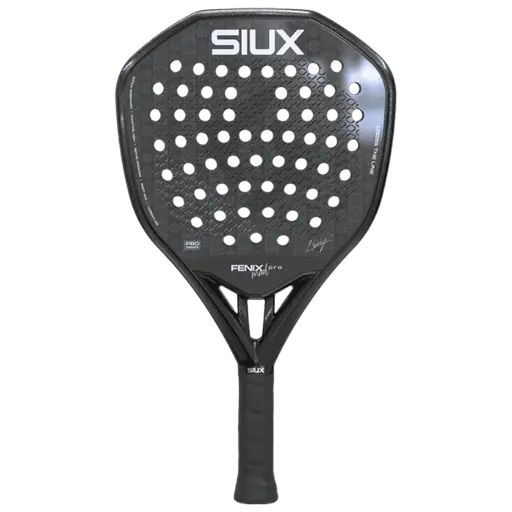
Siux Fenix Pro MAD SE 2026 is a blunt attacking racket: a diamond shape, high balance, and a clearly hard feel built around finishing points above the net.
I see it for advanced players who generate their own racket speed and want a demanding response, not players looking for easy depth from the baseline.
Technical analysis
Shape & balance
The diamond mold puts the sweet spot high, and the balance follows it. That gives the racket real leverage on overheads, especially when I can contact the ball cleanly and in front of my body. A well-timed smash carries serious weight without needing a huge swing.
There is a cost. The sweet spot feels compact, and contact toward the frame is unforgiving. If I arrive late to a volley or defend a fast ball with a loose wrist, the racket does not smooth out the mistake. Its head-heavy setup also asks more from the forearm and shoulder over a long match.
Materials & construction
The faces use 12K Honeycomb carbon, paired with a high-hardness EVA core. That construction produces a dry, direct impact rather than a cushioned one. I get a precise sense of where the ball leaves the face, which helps when I am driving a víbora through the middle or aiming a low volley at the feet.
Ball exit is limited compared with a softer racket. I have to put energy into defensive shots; simply presenting the face is not enough. On the other hand, the firm response keeps the racket stable when I accelerate through the ball, rather than letting the face flex and launch it unpredictably.
On-court feel
Baseline play
From the baseline, this is work. Defensive lobs need a full preparation and clean contact because the racket does not give away much rebound. Low-driven lobs can be effective, but only if I get underneath the ball early enough to load the shot.
Blocks against hard volleys are accurate when my technique is set. Late blocks, off-the-wall recovery shots, and stretched defensive positions expose the smaller sweet spot quickly. Players who rely on soft touch and easy ball exit will likely find it tiring.
At the net
At the net, the Fenix makes more sense. Firm volleys come off heavy, with enough stability to hold the racket through contact rather than having it twist. I particularly like the response on aggressive backhand volleys where I want depth without opening the face too much.
Touch shots are less natural. A chiquita or drop shot needs relaxed hands and careful acceleration; the hard layup can make the ball sit up if I get too abrupt.
Smash
This is its natural territory. The head-heavy profile and stiff face reward clean, high contact with genuine finishing power. The feedback from other court tests lines up with what this setup suggests: it performs best when I am attacking overheads with time to set my feet.
It is not a forgiving smash racket, though. Miss the center toward the frame and the feedback is harsh, while repeated full-power overheads can build arm fatigue across a long session.
Conclusion
I would choose this racket if my game is built around taking the net, pressing with volleys, and finishing with a committed smash or aggressive bandeja. It rewards clean mechanics and decisive swings.
The trade-off is clear: less help in defense, limited easy rebound, and a demanding response outside its sweet spot. This is not a relaxed all-court racket. It is an offensive tool for players who can consistently put it in its strongest positions.
What other reviewers say
- Extreme Padelit
Extreme Padel’s team sees it as a finishing weapon for clean, high-ball contact: the head-heavy, stiff setup performs best when attacking overheads. The trade-off is harshness on frame-side mishits and arm fatigue over long sessions.
Switch Intelligence
Be the first to share where you switched from.
Community reviews
Real feedback from players who used this racket.
Add your review
To submit your review, log in first. You can still read all approved community reviews below.
Add review


