

Nox AT10 Genius Ultra Light 2026 Agustin Tapia
A featherweight, soft-touch AT10 that makes volleys and defensive blocks feel effortless, trading adult-level punch for easy handling.
Shape
Tear
Weight
310 - 325 gr
Touch
Soft
Core
HR2
Faces
3K Fiberglass
Frame
Fiberglass
What we like
- Quick handling in net exchanges
- Forgiving off-center fiberglass response
- Easy defensive blocks and lobs
What we don't
- Limited finishing smash power
- Lively exit can overcarry blocks
- Lacks weight on attacking volleys
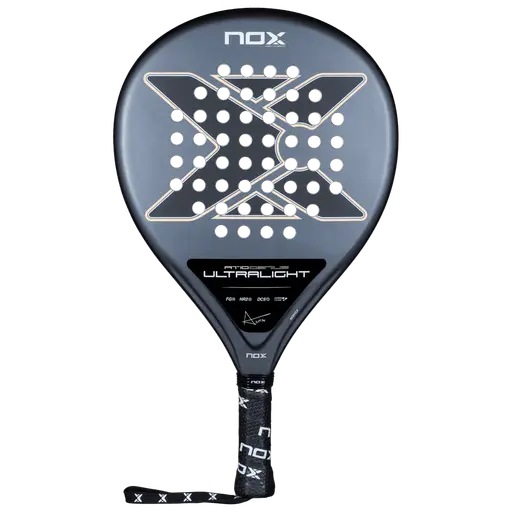
Nox AT10 Genius Ultra Light 2026 Agustin Tapia is a comfort-first racket with a very clear purpose: fast hands, easy ball output, and a large margin for imperfect contact. It carries the AT10 name, but its behavior is much closer to a lightweight, forgiving option than to the more demanding adult versions.
I found it especially suited to players who want to reduce strain through long sessions, younger players moving into a more serious racket, or anyone whose game relies on placement rather than forcing winners.
Power is the compromise. This is not a racket for finishing points with minimal effort.
Technical analysis
Shape & balance
The teardrop shape gives it a generous hitting area without the slow, head-heavy sensation that can come with more attack-focused designs. Its low overall mass and quick handling make preparation very easy, particularly in fast exchanges where there is no time for a full swing.
The balance feels manageable rather than demanding. I could get the racket into position quickly for blocks, defensive lobs, and short reaction volleys. Players accustomed to a heavier AT10 may find it almost too quick at first; there is less mass behind the ball, so timing and clean contact matter if you want depth.
Materials & construction
Nox uses a Fiber Glass frame, Fiber Glass 3K faces, and an HR2 core. Combined with the clearly Soft feel, the result is a flexible, cushioned response with very high ball exit. The fiberglass face does not punish off-center contact much, which matches the forgiving behavior noted in independent play testing.
That softness is useful when the ball arrives fast or low. You do not need to swing hard to send the ball back deep. The downside is a less crisp response on aggressive shots. When I tried to flatten out a volley or accelerate through an overhead, the face compressed easily but did not give me the firm, direct finish of a carbon-faced racket.
On-court feel
Baseline play
From the baseline, this racket is remarkably easy to use. It helps on defensive blocks and off-the-wall play because the ball leaves the face readily, even when the stroke is shortened by pressure. I liked it most when defending hard volleys: just setting the racket face in front of the body was often enough to get a useful return.
Control is strong in the practical sense. The sweet spot feels broad, and the racket is not overly sensitive to slight mishits. Still, the lively response means I had to soften my hands on slower balls. A passive block can travel more than expected, particularly on a warm court.
At the net
At the net, maneuverability is its main advantage. Quick volleys, body shots, and last-second changes of direction are straightforward because the racket does not lag behind the hand. It is also comfortable for repeated exchanges, which matters more than raw power in many club matches.
I would not expect heavy, penetrating volleys from it. You can place the ball well, but opponents will not feel the same weight through the court that a firmer, more head-heavy racket produces. For chiquitas and controlled angles, though, it is very cooperative.
Smash
The smash is where its limits are most obvious. There is enough exit to make a controlled overhead effective, but it does not provide much help when trying to finish from behind the service line. A flat smash needs clean technique and real racket speed; the racket itself will not add much authority.
I preferred using it for placement, low-driven lobs, and a measured bandeja rather than trying to force winners. The soft face keeps those shots comfortable, but it does not create the sharp, loaded response that stronger attackers usually want.
Conclusion
This is a forgiving, highly maneuverable racket for players who value comfort, a large sweet spot, and easy ball exit. It makes defensive play less stressful and feels particularly natural in quick net exchanges.
The trade-off is straightforward: you give up finishing power and a firmer attacking response. Players who regularly rely on an aggressive smash or a heavy víbora will likely outgrow it.
What other reviewers say
- Padel Racket Reviewsen
The review places it firmly on the maneuverability-and-comfort side: it is notably easy to move at the net, while the fiberglass face is forgiving on off-centre contact. In return, its output is far below the adult AT10s and it is not built for finishing power.
Switch Intelligence
Be the first to share where you switched from.
Community reviews
Real feedback from players who used this racket.
Add your review
To submit your review, log in first. You can still read all approved community reviews below.
Add review


