

Tactical El Unico 2026
A firm, quick tear shape that rewards committed swings with heavy pace, yet stays composed enough to work the point from the baseline.
Shape
Tear
Weight
360 - 370 gr
Touch
Medium-Hard
Core
EVA42
Faces
12K Carbon
Frame
Carbon
What we like
- Stable, firm net volleys
- Controlled penetrating overheads
- Direct response on counter-drives
What we don't
- Passive defense lacks ball exit
- Off-center contact feels unforgiving
- Late swings lose control
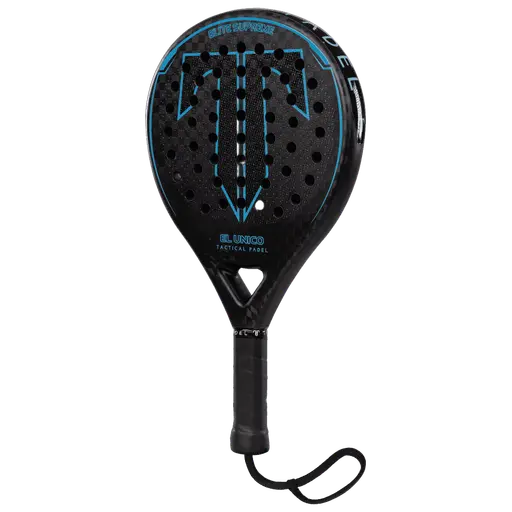
Tactical El Unico 2026 is a control racket with a firm, deliberate response. It gives me the sense of a racket built for players who want to press from the net without giving up the confidence to build points from the baseline.
Its tear shape keeps the profile more balanced than a full diamond, but this is not a soft, forgiving racket. The medium-hard feel asks for clean preparation and purposeful contact.
Technical analysis
Shape & balance
The tear format puts the sweet spot in a useful middle-to-upper area. I find it easier to manage than a head-heavy power racket, especially during quick exchanges, but the balance still gives enough presence through the ball for aggressive volleys and overheads.
That balance also explains its strong maneuverability rating. It comes around quickly enough for reaction blocks and compact backhand volleys, though it does not have the effortless handling of a genuinely head-light control racket. Late contact is still punished; the racket will not rescue a loose arm or a rushed swing.
Materials & construction
The carbon frame and 12K carbon faces point toward a crisp, stable impact rather than a soft, elastic one. On firm contact, the face should feel direct and predictable, with enough rigidity to keep the racket from twisting when receiving pace.
Inside, the EVA42 core supports that firmer character. Ball exit is good once I put something into the shot, but I would not expect free depth from passive swings. Players coming from fiberglass faces or a soft EVA will likely notice less automatic rebound, particularly on slow defensive balls. In return, the response should stay more controlled when I accelerate.
On-court feel
Baseline play
From the back of the court, El Unico looks most comfortable in active defense. Blocks, counter-drives, and low-driven lobs should come off with a clean, stable response, especially when I meet the ball in front. The sweet spot is generous enough for a performance-oriented tear racket, but it is not oversized.
Off-the-wall play requires decent timing. The firmer face gives me useful precision for directing a ball after the glass, yet it does not cushion a poor contact. If your defensive game relies on simply placing the racket behind the ball and letting a soft core do the work, this will feel demanding.
At the net
This is where I would expect the racket to make most sense. The combination of a stable frame and medium-hard response should let me hit a firm volley without the face feeling vague. I can press through the middle, hold a line toward the fence, or take pace off for a short drop shot with reasonable confidence.
Its bite will depend more on my technique than on an excessively textured, grabby face. The racket should reward a committed cut on a chiquita or angled volley, but it is not the kind of racket that manufactures spin by itself.
Bandeja and víbora
The tear shape is a sensible fit for controlled overheads. I would use it to drive a bandeja deep and heavy rather than relying only on flat speed. On the víbora, the firm response should help keep the ball penetrating after the bounce.
A full-power smash is available, but this is not a pure cannon built around effortless finishing. The power is there when I load the shot properly; casual technique will not unlock all of it.
Conclusion
I would put El Unico in the hands of an intermediate-to-advanced player who likes to take initiative at the net, hits overheads with intent, and prefers a direct carbon response over a soft, bouncy feel.
The trade-off is clear. It offers strong power and control on committed shots, but less help on passive defense and off-center contact than softer rackets. Players wanting easy ball exit or a plush touch may find it too firm.
Switch Intelligence
Be the first to share where you switched from.
Community reviews
Real feedback from players who used this racket.
Add your review
To submit your review, log in first. You can still read all approved community reviews below.
Add review


