

Tactical El Toro 2026
A teardrop built to finish with authority, yet composed enough to keep the baseline and the net connected under pressure.
No store price yet
See similar racketsShape
Tear
Weight
355 - 365 gr
Touch
Medium-Hard
Faces
12K Lightweight Carbon Fiber
What we like
- Authoritative volleys without overswinging
- Penetrating *bandeja* and *víbora*
- Controlled low-driven lob response
What we don't
- Demanding late defensive blocks
- Off-center hits feel harsher
- Delicate touch shots demand precision
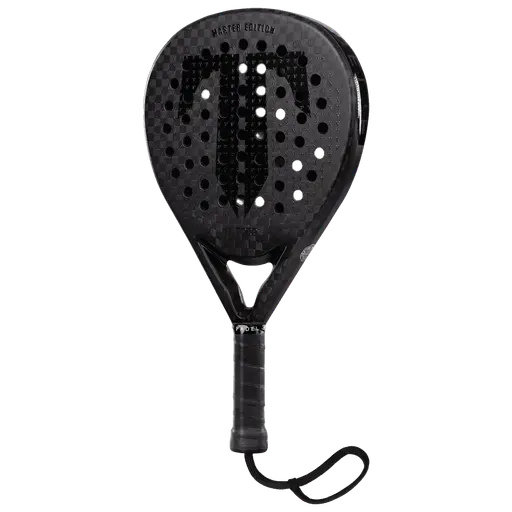
Tactical El Toro 2026 is built around controlled aggression: enough head presence to make overheads count, without the slow, blunt character of a full diamond racket. It looks aimed at the player who wants to finish points rather than simply keep the ball in play.
I’d expect its medium-hard feel to reward a committed swing. This is not a soft, automatic racket that produces easy depth from a passive contact.
There is still limited independent court feedback around this model, so the on-court assessment below follows its stated construction and balance-oriented design rather than borrowed hype.
Technical analysis
Shape & balance
The teardrop shape puts El Toro in a useful middle ground. The sweet spot should sit higher than on a round control racket, helping the racket carry more authority through volleys, bandejas, and attacking lobs, but without demanding the timing of a very head-heavy diamond.
Its maneuverability rating suggests Tactical has not pushed all the mass toward the tip. That matters at the net, where I want a racket that can change direction quickly after a fast exchange. Still, this is unlikely to feel head-light. Players who rely on quick wrist blocks or late defensive reactions may find it more demanding than a round model.
Materials & construction
The faces use 12K Lightweight Carbon Fiber, a layup that should give the racket a firmer, more immediate response than fiberglass. Combined with the medium-hard profile, I’d expect a crisp hit rather than a long, cushioned ball dwell.
That construction should suit players who create their own acceleration and want a clean connection on flat volleys and overheads. The trade-off is comfort: off-center contact will probably feel more noticeable, especially against heavy balls. Tactical does not list the frame or core composition, so I would be cautious about making bigger claims regarding vibration filtering or long-term durability.
On-court feel
Baseline play
From the baseline, El Toro should be more about directing a deliberate ball than rescuing a poor one. The reasonably broad sweet spot suggested by its rating ought to give it more forgiveness than an outright power racket, while the firmer faces should help keep a low-driven lob from floating.
I would not choose it for effortless defensive depth. On a hurried block or a late off-the-wall ball, medium-hard rackets generally need cleaner contact and more push from the player. If your defense depends on the racket supplying free ball exit, there are softer options that will be easier to live with.
At the net
This is where the specification makes the most sense. The teardrop profile and power-focused response should let you hit a firm volley without over-swinging, while the reported maneuverability should keep quick exchanges manageable. I’d expect particularly good results when punching the ball through the middle or taking pace off with a compact drop shot.
Touch shots will need a measured hand. A firmer carbon face can be accurate, but it does not naturally soften the ball for you. The chiquita and short angled volley may demand more precision than they would with a softer control racket.
Bandeja and víbora
El Toro’s likely higher contact point should help on the bandeja and víbora. It ought to produce a penetrating ball when I can accelerate through the shot, with enough control to keep the ball low rather than simply hitting hard.
For a flat smash, the listed power is promising, but this is not automatically a racket for every player looking to bring the ball back over the fence. Technique, timing, and acceleration will still decide that shot.
Conclusion
El Toro makes sense for intermediate-to-advanced players who attack regularly, use overheads to build pressure, and prefer a direct carbon response over a soft, springy feel.
The trade-off is clear: it should give more authority at the net and on aggressive overheads than a forgiving round racket, but asks more from defensive contacts and delicate touch play. I would avoid it if comfort and easy ball exit are the priorities.
Switch Intelligence
Be the first to share where you switched from.
Community reviews
Real feedback from players who used this racket.
1 review

Add your review
To submit your review, log in first. You can still read all approved community reviews below.
Add review


