

Tactical Katana 2026
A quick, firm teardrop that finds easy depth and carries real finishing weight once its initially stiff response starts to settle.
Shape
Tear
Weight
355 - 365 gr
Touch
Medium-Hard
Core
Medium-hard EVA
Faces
12K carbon fiber
What we like
- Easy depth on compact swings
- Quick handling in net exchanges
- Direct *bandeja* and *víbora* exit
What we don't
- Firm feel during break-in
- Lively face punishes loose touch
- Limited soft absorption on blocks
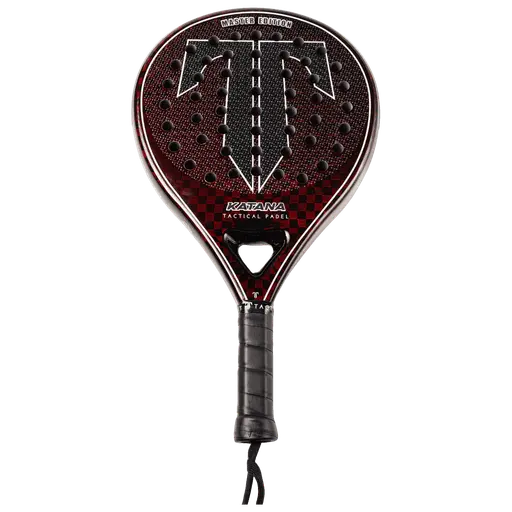
Tactical Katana 2026 is a versatile racket with easier ball exit than its firm face suggests. I see it as a fast, direct option for players who want to create depth and finish points without needing to overswing.
Its tear shape keeps it more manageable than a full diamond, while the medium-hard feel gives it a clear preference for purposeful, forward-moving shots. It is not a plush, slow-control racket. It wants the ball to leave with intent.
Technical analysis
Shape & balance
The tear profile gives the Katana a useful middle ground: enough mass through the top of the racket to make overheads count, without becoming cumbersome in quick exchanges. Its relatively light build is part of that character. I found it easier to get the racket into position than many power-focused models, particularly on rushed volleys and defensive blocks.
That said, it does not feel head-light in the way a pure control racket does. There is still enough presence toward the upper part of the frame to reward a committed swing. Players who like to wait on the ball and guide every shot may find it a little more reactive than they expect.
Materials & construction
The 12K carbon fiber faces and medium-hard EVA core produce a firm, crisp response, especially on clean contact. Early feedback from regular users also points to a noticeably firmer feel during the first sessions, before the racket settles and becomes less rigid. I would allow for that break-in period rather than judging it from one match.
What stands out is the amount of ball exit available for this construction. Compared with Tactical’s firmer, more demanding options, the Katana needs less arm acceleration to send the ball deep. That makes the racket more forgiving on medium-paced swings, but it also means delicate touch shots can spring off the face if your hand is too loose.
On-court feel
Baseline play
From the baseline, the Katana helps on defensive lobs and off-the-wall balls where I want depth without taking a huge cut. The response is lively enough that a compact swing can still push opponents back. That is a real advantage late in long points.
Control remains good, but it is not passive control. I need to set the face cleanly on blocks and low balls. If I catch the ball too high on the face or open the racket carelessly, the extra exit can send it longer than intended. Players who rely on a very soft core to absorb pace will not get that cushion here.
At the net
At the net, the Katana feels quick and useful. Volleys come off with enough penetration to pressure without needing a violent punch, and the sweet spot is broad enough to keep fast exchanges from becoming stressful. The racket’s maneuverability also helps when changing from a firm volley to a short chiquita.
Touch is the compromise. Drop shots and very soft angled volleys require a quieter hand than with a softer fiberglass racket. The firm face gives clean feedback, but it does not hide poor contact.
Bandeja and víbora
This is one of its stronger areas. The racket accelerates easily through a bandeja, and the available ball exit helps maintain depth even when I am playing the shot conservatively. On the víbora, the face feels direct enough to drive through the ball rather than simply float it.
Conclusion
I would put the Katana in the hands of an intermediate-to-advanced player who wants accessible power, quick handling, and more help generating depth than a traditional hard-control racket provides.
The trade-off is clear: its initial firmness and lively output demand touch adjustment. It will reward active, attacking padel, but it is not the racket I would choose for a player whose game depends on soft absorption and ultra-fine feel.
What other reviewers say
- r/Padelracket (Reddit)en
A player who has used the full range describes the Katana as medium-hard, with markedly more ball output and power than the El Jefe, so it needs less arm acceleration. They also note that it feels quite firm initially before easing up with use.
- r/Padelracket (Reddit)en
In a lightweight-racket recommendation, the Katana is placed around 355–360 g and characterized as medium-soft with more ball output than the El Jefe. The impression is of a light option that helps produce depth without as much effort.
Switch Intelligence
Be the first to share where you switched from.
Community reviews
Real feedback from players who used this racket.
Add your review
To submit your review, log in first. You can still read all approved community reviews below.
Add review


